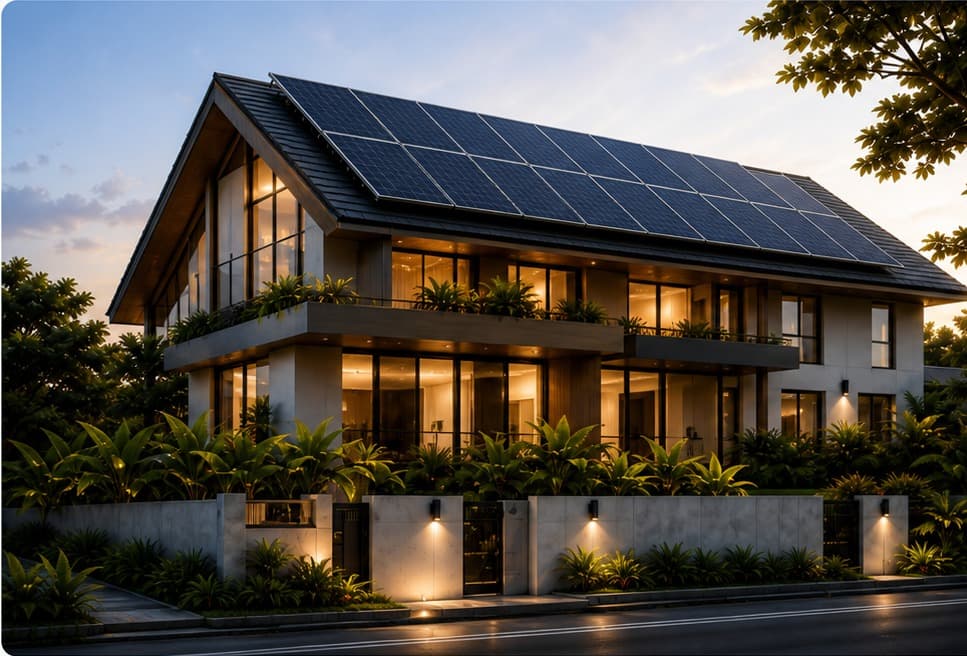
Solar panels for Singapore terrace houses
Most Singapore terrace houses fit 10 to 15 kWp. At the current Q3 2026 tariff of S$0.3478/kWh, that saves S$3,100 to S$4,654 per year and pays back in 3.5 to 4.5 years.
Quick answer
A standard terrace house with 100 to 160 sqm of roof typically supports a 12 to 15 kWp system costing S$15,000 to S$21,000. At the Q3 2026 SP Group tariff, annual savings are approximately S$3,700 to S$4,654. Payback runs 3.7 to 4.5 years. After that, the system generates for free for the remaining 20-plus years of its life.
10–15 kWp
Typical system size
S$15k–21k
Typical installed cost
3.5–4.5 yrs
Payback at Q3 2026 tariff
Numbers based on SP Group Q3 2026 tariff of S$0.3478/kWh, Solar Capacity Tariff of S$0.2581/kWh, 25% self-consumption, and Singapore irradiance of 4.33 peak sun hours per day with 30% system losses.
Your numbers by system size
What each size saves at the record tariff.
Savings and payback at Q3 2026 SP Group tariff of S$0.3478/kWh. Each tariff increase after your install date improves these figures automatically — the Q3 2026 tariff is the highest on record.
| System size | Installed cost | Annual savings | Payback |
|---|---|---|---|
| 10 kWp | S$13,000–16,000 | ~S$3,100 | 4.2–5.2 yrs |
| 12 kWp | S$15,000–18,000 | ~S$3,720 | 4.0–4.8 yrs |
| 15 kWp | S$17,000–21,000 | ~S$4,654 | 3.7–4.5 yrs |
Savings = self-consumption saving (25%) at S$0.3478/kWh + export credit (75%) at S$0.2581/kWh. Payback range reflects cost variance by installer and roof complexity.
Fill the roof. The marginal cost of adding more capacity is low once the installer, scaffolding, and permits are already on-site. A 15 kWp system costs only S$2,000 to S$5,000 more than a 10 kWp, but saves S$1,500 more per year. The larger system is almost always the better investment.
What affects your system size
Three things set your capacity.
Roof area
A standard Singapore terrace has 100 to 160 sqm of roof. After accounting for the water tank, eaves setback, and shade from neighbours, usable area is typically 60 to 110 sqm — enough for 10 to 18 panels per sqm needed.
Orientation
South-facing is ideal, but Singapore is near the equator, so both north and south faces get strong irradiance year-round. East-west splits generate well too; only steep north-facing pitch in deep shade underperforms.
Phase supply
Single-phase supply caps your system at roughly 13 kWp. Three-phase lets you go up to 20 kWp or more, and unlocks a lower cost per kWp. Check your DB before getting quotes.
The LEW sign-off you need
Every Singapore solar installation requires a Licensed Electrical Worker (LEW) to inspect and certify the wiring. Your installer arranges this. The LEW certificate is also the document your home insurer needs when you declare the installation — do not skip it.
Your terrace, your numbers
Every terrace is different. See yours.
Roof orientation, shading, phase supply, and your bill all move the savings figure. The Sunnify estimate uses your specific inputs and the current Q3 2026 tariff to give you numbers that apply to your house, not the average.
Common questions
Terrace house solar, answered.
Most Singapore terrace houses fit 25 to 45 panels, depending on usable roof area after setbacks and the water tank. Each standard 400W panel needs roughly 2 sqm. A typical installation runs 30 to 38 panels for a 12 to 15 kWp system.
At the Q3 2026 SP Group tariff of S$0.3478/kWh, a 15 kWp system on a Singapore terrace house pays back in approximately 3.7 to 4.5 years on a system costing S$17,000 to S$21,000. A 10 kWp system pays back in 4.2 to 5.2 years. Payback shortens automatically each time SP Group raises the tariff.
No. Each terrace unit has its own roof section. The party wall stops at the ridge line, and your solar panels mount entirely on your own roof. Your neighbour's installation, if any, is on their roof. There is no shared consent required for a standard terrace solar installation.
Yes. EMA permits single-phase residential connections up to 13 kWp AC output. Many installers design a 12 to 13 kWp system on single-phase by using a suitably rated inverter and staying within the SP Group export limit. Beyond that, you would need to upgrade to three-phase supply, which is possible but adds S$2,000 to S$5,000 to the project cost.
Once your installation is registered with EMA and SP Group, every kWh you generate and do not self-consume is exported to the grid at the Solar Capacity Tariff (SCT). For Q3 2026, the SCT is S$0.2581/kWh. SP Group pays this credit on your monthly bill. You do not need to switch suppliers or take any ongoing action once registration is complete.
A 15 kWp system on a Singapore terrace house typically costs S$17,000 to S$21,000 fully installed, including panels, inverter, mounting, wiring, scaffolding, permits, and SP Group grid connection. At S$0.3478/kWh, expected annual savings are approximately S$4,654, giving a payback of 3.7 to 4.5 years.
Go deeper
The detail, if you want it.
Keep reading
The rest of the decision.
Is it worth it?
Are solar panels worth it?
The honest verdict, the real payback, and when it is not worth it.
Read guideWhat it costs
How much does solar cost?
Real 2026 prices, per kWp and total, and where every dollar goes.
Read guideWill it fit?
Is my roof suitable?
Size, shading, orientation, and supply, checked the honest way.
Read guideWho to trust
How to choose an installer
Green flags, red flags, and the questions that protect you.
Read guide