How long is the solar payback period in Singapore?
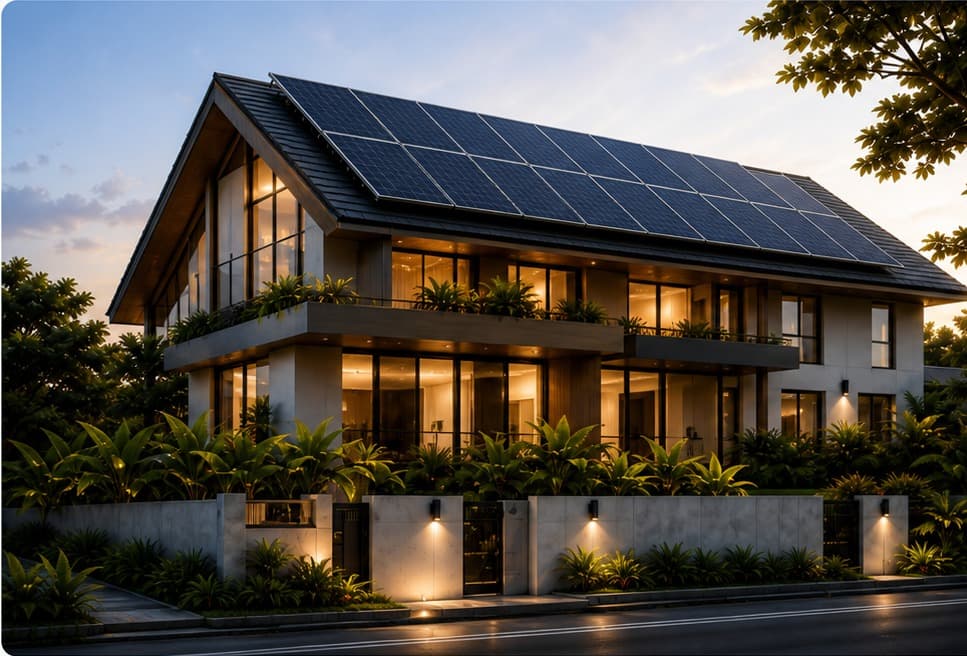
For most suitable landed homes, about 5 to 6 years. After that, the system keeps generating for another 15 to 20, so the savings are effectively free power.
Payback by bill
Roughly what to expect.
A rule of thumb by monthly electricity bill, at today’s prices and SP tariffs. Yours will differ, so see your own figure. For the full installed solar panel cost in Singapore that feeds these numbers, see the cost guide.
What moves it
What speeds it up, what slows it.
Shortens payback
- A bigger system, which costs less per kWp
- More daytime usage, so more solar is self-consumed
- A sunny, low-shade roof
- Three-phase supply, which unlocks larger systems
Lengthens payback
- A small system or low bill, which raises the cost per kWp
- Heavy shading across the middle of the day
- A tiled roof or tricky access, which adds install cost
Common questions
Payback, answered.
About 5 to 6 years for most suitable landed homes at current installed prices and SP 2025 tariffs. Bigger systems on higher bills sit at the faster end.
It is an honest planning range from your bill and roof. A site survey confirms it precisely, accounting for your real shading, roof, and electrical setup.
Mostly inertia, not a hidden catch. Private landed homes don't get the kind of government push HDB blocks do, the upfront cost is real money, and most people simply haven't seen the actual numbers for their own roof yet. Adoption is accelerating as more landed homeowners see real installs nearby and energy prices stay front of mind.
Five to seven years is a strong result for a 25-year system. Below five years is excellent. Above eight years on a suitable roof usually points to an oversized system, a higher installed cost, or low daytime usage. Compare your payback against the system's full 25-year lifespan, not just the raw number.
Yes. If the SP tariff rises, your self-consumed solar saves more per unit and your effective payback shortens. The calculator uses the current SP 2025 Q2 tariff of S$0.297 per kWh. Any future tariff increase improves your actual returns beyond what the estimate shows.
Yes. A complete payback calculation includes roughly S$400 per year for cleaning and periodic checks, plus one inverter replacement over the system's 25-year life. Leaving these out gives an overly optimistic payback figure. The Sunnify estimate uses S$400 per year as the maintenance baseline.
No. Adding a battery increases the upfront cost by S$8,000 to S$20,000, which lengthens payback significantly. A battery makes sense for energy security or shifting evening usage off the grid, not for improving payback speed. The two decisions are worth separating: get the solar system to payback first.
Keep reading
The rest of the decision.
Is it worth it?
Are solar panels worth it?
The honest verdict, the real payback, and when it is not worth it.
Read guideWhat it costs
How much does solar cost?
Real 2026 prices, per kWp and total, and where every dollar goes.
Read guideWill it fit?
Is my roof suitable?
Size, shading, orientation, and supply, checked the honest way.
Read guideWho to trust
How to choose an installer
Green flags, red flags, and the questions that protect you.
Read guide