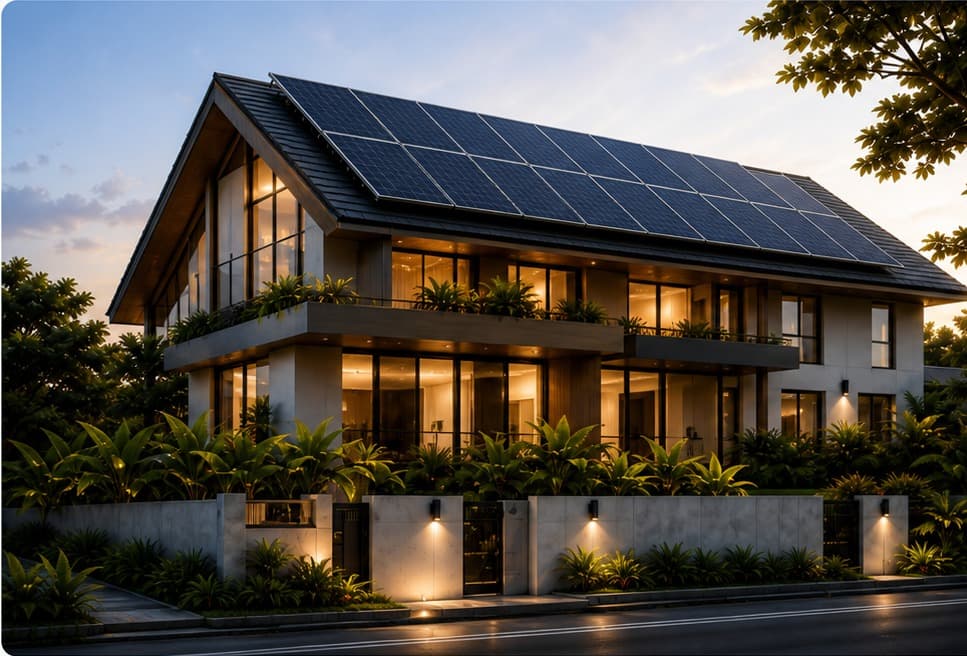
Solar panels for semi-detached houses in Singapore
Semi-detached homes install on one roof half, typically fitting 8 to 12 kWp. At the current Q3 2026 tariff, that saves S$2,500 to S$3,720 per year with payback in 4 to 5 years.
Quick answer
A Singapore semi-detached house typically fits 8 to 12 kWp on one roof half, costing S$10,000 to S$18,000. At Q3 2026 tariff of S$0.3478/kWh, annual savings run S$2,480 to S$3,720. Payback is 4 to 5.2 years. No consent from your neighbour is needed.
8–12 kWp
Typical system size
S$10k–18k
Typical installed cost
4–5.5 yrs
Payback at Q3 2026 tariff
Numbers based on SP Group Q3 2026 tariff of S$0.3478/kWh, Solar Capacity Tariff of S$0.2581/kWh, 25% self-consumption, Singapore irradiance of 4.33 peak sun hours per day with 30% system losses.
Savings by system size
What your half-roof earns.
Annual savings at Q3 2026 SP Group tariff of S$0.3478/kWh. The Solar Capacity Tariff for exported units is S$0.2581/kWh. Both figures are the highest on record.
| System size | Installed cost | Annual savings | Payback |
|---|---|---|---|
| 8 kWp | S$10,000–13,000 | ~S$2,480 | 4.0–5.2 yrs |
| 10 kWp | S$13,000–16,000 | ~S$3,100 | 4.2–5.2 yrs |
| 12 kWp | S$15,000–18,000 | ~S$3,720 | 4.0–4.8 yrs |
Savings = self-consumption saving (25%) at S$0.3478/kWh + export credit (75%) at S$0.2581/kWh.
The smaller roof is not a dealbreaker. Payback on a semi-detached is 4 to 5.5 years versus 3.5 to 4.5 years for a terrace. Still a strong investment, and the 20-plus years of free generation after payback is identical. See the full case in the is solar worth it guide.
What is different about a semi-D roof
One roof half. Three things to check.
Only your half
A semi-detached has two mirror-image units sharing a ridge. You install on your half only. Usable area is typically 50 to 85 sqm after setbacks, supporting 8 to 14 panels per row.
Roof pitch and shape
Semi-detached roofs in Singapore are typically pitched at 25 to 35 degrees. The usable side depends on orientation — a south-west facing pitch generates more than north-east in Singapore's irradiance conditions.
Shading from neighbours
The shared wall and neighbouring structure can cast shade on your panels in the late afternoon. An installer should check for this with a shade analysis before sizing your system.
Compared to a terrace house
Semi-detached
- One roof half only
- 50 to 85 sqm usable area
- 8 to 12 kWp typical
- No neighbour consent needed
Terrace house
- Full roof (both faces)
- 60 to 110 sqm usable area
- 10 to 15 kWp typical
- No shared consent needed
Your semi-D, your numbers
One roof half is enough.
Half the roof still means 20-plus years of free generation after payback. Use the Sunnify estimate to see your specific system size, cost, and savings based on your roof, your bill, and the current tariff.
Common questions
Semi-detached solar, answered.
Most Singapore semi-detached houses fit 20 to 30 panels on one roof half, depending on usable area and roof pitch. Each standard 400W panel needs approximately 2 sqm. A typical installation runs 22 to 28 panels for an 8 to 11 kWp system.
No. Each unit installs on its own roof section. There is no shared consent required for a semi-detached solar installation in Singapore. Your panels sit entirely on your side of the shared ridge. The only approval you need is EMA equipment approval and SP Group registration, which your installer handles.
At the Q3 2026 SP Group tariff of S$0.3478/kWh, a 10 kWp system on a Singapore semi-detached pays back in approximately 4.2 to 5.2 years on a system costing S$13,000 to S$16,000. A 12 kWp system pays back in 4.0 to 4.8 years.
Yes. Corner semi-detached homes often have more usable roof area than standard units because the end unit is not flanked on both sides. An inter-terrace semi-detached is sized similar to a standard unit. In both cases, the process — EMA approval, LEW sign-off, SP Group registration — is the same.
Each unit installs independently on its own roof. Your neighbour's installation does not affect your ability to install. The only practical consideration is if your neighbour's equipment affects shading on your side, which is unlikely given the shared ridge orientation.
Fill whatever usable roof area you have. The same principle applies as for a terrace: marginal cost per additional kWp is low once scaffolding and labour are already on-site. An installer quote for your specific roof will tell you the maximum system size, and it is almost always better to go to the maximum than to deliberately undersize.
Go deeper
The detail, if you want it.
Keep reading
The rest of the decision.
Is it worth it?
Are solar panels worth it?
The honest verdict, the real payback, and when it is not worth it.
Read guideWhat it costs
How much does solar cost?
Real 2026 prices, per kWp and total, and where every dollar goes.
Read guideWill it fit?
Is my roof suitable?
Size, shading, orientation, and supply, checked the honest way.
Read guideWho to trust
How to choose an installer
Green flags, red flags, and the questions that protect you.
Read guide