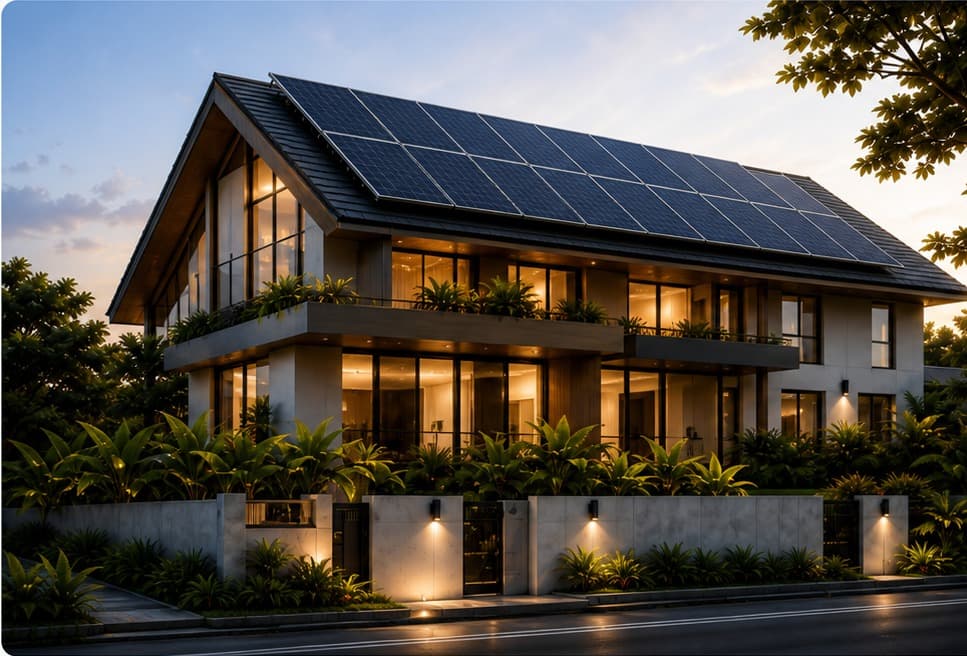
Can Strata-Titled and Cluster Homes Go Solar in Singapore?
Cluster homes and strata-titled landed properties in Singapore can install solar, but roof ownership determines the process. If the roof is private property, proceed normally. If it is common property, MCST approval is required — achievable with the right proposal structure.
Key Takeaways
- 1
Strata-titled landed properties in Singapore include cluster houses and townhouses — the roof may be common property, requiring MCST approval before installation
- 2
If the roof is common property, you can still install solar by presenting a compelling proposal to the MCST, backed by shared savings or system ownership structures
- 3
For cluster homes where the roof above your unit is private property rather than common property, installation proceeds the same as a standard landed home

Singapore's landed property market includes a category that sits between private landed and strata apartment: cluster houses, townhouses, and strata-titled bungalows. These properties share common areas managed by a Management Corporation Strata Title (MCST), and the roof may or may not be part of that common area. Before any solar installation conversation, this single question determines everything: who legally owns the roof above your unit?
The Core Legal Distinction
In Singapore, strata-titled properties divide ownership between private units (what you own outright) and common property (managed collectively by the MCST). For most strata-titled landed homes, the answer to who owns the roof depends on the specific strata subdivision plan registered with Singapore Land Authority.
In some cluster developments, the roof above each individual unit is included in that unit's private lot, meaning you own it and can proceed with solar exactly as a standard landed homeowner would, with no MCST involvement required. In other developments, the roof is designated as common property, which means the MCST has legal authority over its use and must approve any installation. Ask your managing agent to check the strata plan if you are unsure.

If the Roof Is Private Property: Proceed Normally
If your strata plan confirms the roof above your unit is private strata lot area (not common property), you are in the same position as any private landed homeowner. The process is standard: site survey, quote, LEW sign-off, SP Group ECIS registration. No MCST involvement required. Your solar system, your roof, your decision.
One caveat: even if the roof is private, your strata by-laws may include aesthetic restrictions that technically apply to external modifications visible from the development's common areas. Review your MCST by-laws for any clause on external appearance. In practice, most MCSTs do not actively police solar installations on private roof areas, but confirming this in advance avoids a later dispute.
If the Roof Is Common Property: The MCST Approval Pathway
When the roof is common property, you need a resolution passed by the MCST to authorise your installation. This typically requires a general meeting resolution, either a simple majority or a special resolution depending on whether the installation affects common property permanently.
The practical pathway: approach the MCST secretary with a written proposal before any general meeting. Frame the proposal around shared benefits where possible. Two structures work well. First: you install a system sized for your unit, but offer shared savings on common area electricity (lifts, lighting, landscaping) if the cluster shares a common meter. Second: propose a development-wide installation where multiple units co-invest, reducing per-unit cost through bulk procurement and making the shared roof a shared asset. Most MCSTs are more receptive to the second framing because it presents solar as a community benefit rather than an individual ask.
What to Do If the MCST Says No
If the MCST declines your proposal, you have limited recourse for a roof that is genuinely common property. You cannot install solar without their authorisation, and a legal challenge is disproportionate for a residential solar system. The practical options: raise it again at the next annual general meeting with a revised proposal (often a shared development-wide system lands better the second time), seek allies among other unit owners who would benefit, or accept that the timing is not right and revisit when the MCST composition changes.
One structural route that occasionally works: propose a community solar arrangement through EMA's Enhanced Central Intermediary Scheme, where the entire development installs as a multi-unit site with shared metering and credits distributed to individual units through MCST accounting. This requires EMA engagement and is more complex, but it may appeal to an MCST that rejected a single-unit proposal but would consider a development-wide upgrade.

The strata roof ownership question is the one check that determines whether your cluster home solar project takes four weeks or four months. Ask your managing agent before you speak to an installer.
For a site-specific estimate once you have confirmed your roof ownership status, use the Sunnify estimate tool. The tool works for cluster home units the same as a standard terrace, the key inputs are roof area available and household consumption.
Further reading: BCA strata property solar guidelines · HDB community solar programme.
What vote threshold is needed at an MCST general meeting to approve a solar installation?
Under Singapore's Building Maintenance and Strata Management Act (BMSMA), improvements to common property generally require a special resolution — 75% of the total share value of the strata roll must vote in favour. If your solar installation is classified as a limited common property improvement (benefiting only your unit), the threshold may be different depending on your by-laws. Consult your MCST secretary and a property lawyer familiar with Singapore strata law for the specific threshold that applies to your development's by-laws and the nature of your proposed installation.
Can a strata cluster home owner register for ECIS with SP Group individually?
Yes, if you have a separate SP Group account for your unit and the solar system is wired to your unit's meter. Each ECIS application is linked to a specific meter point (utility account), so as long as your unit has its own metered connection, you can register independently regardless of the strata structure. The complication arises if your development shares a single master meter, in that case, the ECIS registration would need to happen at the master meter level through the MCST, which requires the MCST's involvement in the application.
See your numbers
What does this mean for your home?
Tariffs and technology change the math. The calculator uses current SP figures to show your actual payback and savings.