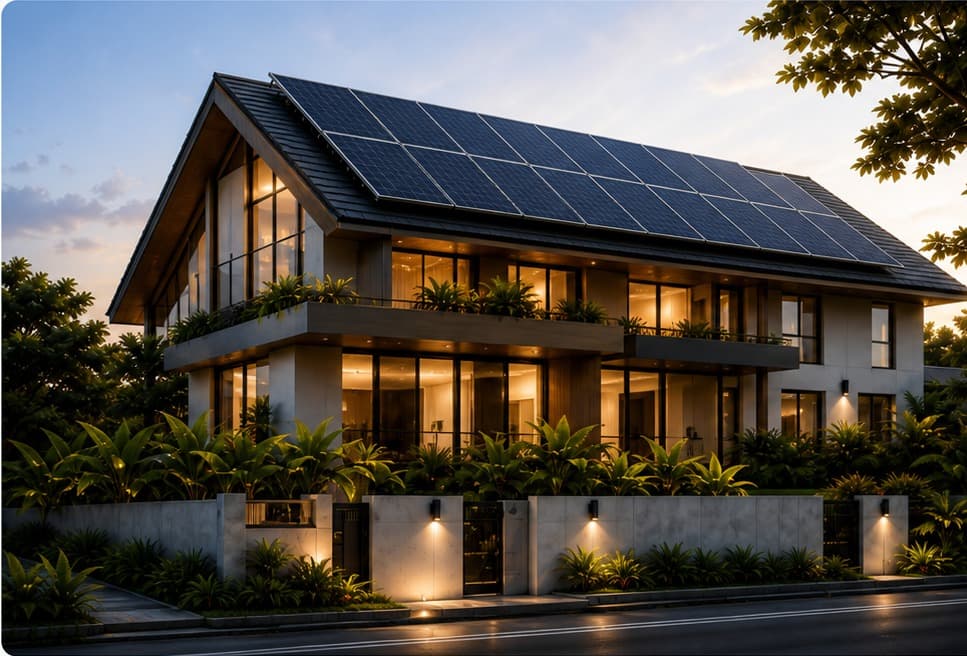
Good Class Bungalow Solar Singapore: 20kWp+ Systems and Premium Returns
Good Class Bungalows with 200 to 500 sqm of usable roof area can accommodate Singapore's largest residential solar systems at 20 to 40kWp. The economics improve at scale: cost per kWp falls, self-consumption rises with larger household loads, and 25-year net returns reach S$135,000 to S$270,000.
Key Takeaways
- 1
A GCB with 200 sqm of usable roof area can support 20 to 30kWp of solar — the largest residential systems in Singapore
- 2
At 20kWp and 35% self-consumption, annual savings reach approximately S$6,400 with a 3.9-year payback and a S$135,000 25-year net return
- 3
Larger GCB systems may require a three-phase connection upgrade — worth checking with SP Group early in the planning process as this can affect both cost and timeline

Good Class Bungalows represent Singapore's most attractive residential solar opportunity in absolute return terms. Large roof areas, high household electricity consumption from pool pumps, multiple aircon zones, and extensive lighting — and the financial profile where a S$25,000 to S$60,000 solar investment is proportionate to the property value and the household's energy expenditure. The economics improve at scale: cost per kWp falls below S$1,250 for systems above 20kWp, and the self-consumption ratio rises as a larger household baseline load absorbs more of the daytime generation.
GCB Roof Area and System Size Potential
GCB plots in Singapore are a minimum of 1,400 sqm in land area, but the building footprint and roof configuration determine solar capacity. A 2-storey GCB with a traditional pitched tile roof typically presents 200 to 350 sqm of gross roof area. After deducting ridge zones, overhangs, and mechanical equipment placement, usable panel area is usually 150 to 250 sqm.
At 2 sqm per panel with racking clearances, 200 sqm of usable area supports approximately 100 panels. At 450W per panel, that is 45kWp — though EMA's grid connection limits for single-phase properties cap export at 5kW, and most residential GCBs will size to 20 to 30kWp to stay within practical inverter and connection limits. A three-phase connection unlocks higher capacity.

Three System Size Scenarios for a Singapore GCB
| System Size | Generation/yr | Annual Saving | System Cost | Payback | 25yr Net |
|---|---|---|---|---|---|
| 20 kWp | 22,120 kWh | S$6,403/yr | S$25,000 | 3.9 yrs | ~S$135,100 |
| 30 kWp | 33,180 kWh | S$9,405/yr | S$36,000 | 3.8 yrs | ~S$199,100 |
| 40 kWp | 44,240 kWh | S$12,260/yr | S$46,000 | 3.8 yrs | ~S$260,500 |
These figures use 40% self-consumption for the GCB household, reflecting a large household load from pool pumps, multiple helper rooms, multiple aircon zones, and potentially EV charging. At 40% self-consumption (S$0.3478/kWh) and 60% export (S$0.2581/kWh), the effective blended saving rate is S$0.277/kWh generated. Cost per kWp at 30kWp and above typically falls to S$1,150 to S$1,250 with economies of scale.
The Three-Phase Connection Question
Most Singapore residential properties are on a single-phase connection from SP Group, which limits the practical solar system to approximately 10 to 15kWp on a single inverter before export limitations become a constraint. For GCBs wanting 20kWp or more, a three-phase connection opens up the full roof capacity.
Upgrading to a three-phase connection through SP Group involves an application process, potentially new cabling from the street, and a fee that varies by property and infrastructure distance. The timeline can add 4 to 12 weeks to the overall project. For a GCB with known solar plans, raise the three-phase question with SP Group before signing any installation contract, so the timeline does not become a surprise.

The GCB is not just the biggest solar system in Singapore's residential sector. At scale, it is the investment with the best absolute return — S$200,000 net over 25 years for a property that could spend that much on air conditioning alone.
Battery integration at GCB scale makes most economic sense when the household has a pool pump, EV charger, or high overnight consumption baseline that can be shifted to battery-stored daytime solar. The complete home energy system guide covers solar, battery, and EV together for large properties. For your property-specific estimate, run the Sunnify estimate tool.
Further reading: URA Good Class Bungalow area planning regulations · BCA solar installation permit guide · EMA large-scale solar connection.
Are there planning restrictions on solar panels for GCBs in Singapore?
GCBs are in designated Good Class Bungalow areas with specific planning controls managed by URA. Solar panels are generally permitted as they are considered part of the building's mechanical and electrical systems rather than a change to the approved building form. However, GCB areas may have aesthetic guidelines affecting panel visibility from the street. Check with your architect or URA's planning advisory service if your GCB has a conservation designation or sits in a particularly sensitive streetscape. Most GCBs with rear or side-facing roof areas proceed without issue.
Can a GCB use solar to charge an EV and run a pool pump?
Yes, and this is where the self-consumption economics of a large GCB system become most compelling. A pool pump typically uses 0.75 to 2.5kW continuously during operation hours, while an EV charger draws 7 to 22kW during charging sessions. Scheduling pool pump operation and EV charging during peak solar generation hours (9am to 3pm) significantly raises the self-consumption ratio and reduces the electricity exported at the lower SCT rate. A home energy management system can automate this scheduling. The solar-battery-EV combination for large properties is covered in detail separately.
See your numbers
What does this mean for your home?
Tariffs and technology change the math. The calculator uses current SP figures to show your actual payback and savings.