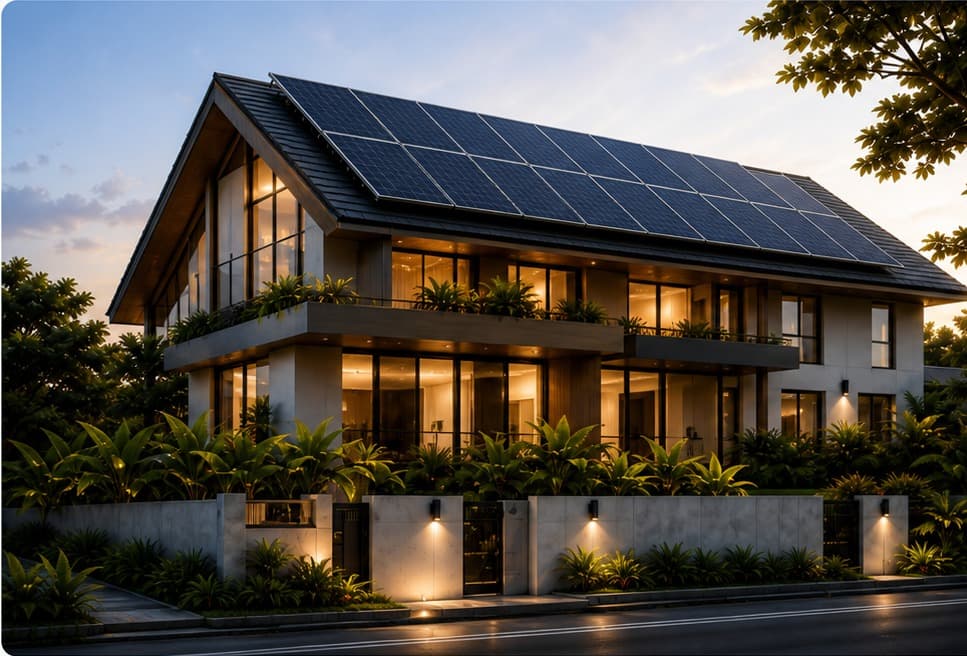
Roof Types in Singapore: Which Works Best for Solar?
Singapore's four common residential roof types — clay tile, metal standing seam, concrete flat, and zinc/Colorbond — all support solar installation. Metal standing seam is the easiest and fastest to work with. Clay tile is the most common and works well but may require structural assessment on older roofs.
Key Takeaways
- 1
Clay tile roofs are the most common in older Singapore terraces — solar works well on them using rail-and-hook mounting, but roofs over 15 years old may need a structural assessment
- 2
Metal standing seam roofs are the easiest and cheapest to mount solar on — clamp systems require no penetration and installation is faster
- 3
Concrete flat roofs require either ballasted (no-penetration) or penetrating racking — both work, but waterproofing quality around any penetration is critical in Singapore's rainfall climate

Homeowners in Singapore worry that their roof type disqualifies them from solar before they have even spoken to an installer. In almost every case, it does not. Singapore's four common residential roof types all support solar installation, the difference is in mounting method, structural requirements, and installation time. One roof type genuinely makes solar difficult. The other three are straightforward once you understand the approach.
Clay and Ceramic Tile Roofs: The Most Common Singapore Configuration
The majority of pre-2000 Singapore terrace and semi-D houses have clay or ceramic tile roofs. These are the orange-red S-shaped or flat tiles visible on most established landed estates. Solar panels mount using a rail-and-hook system: hooks attach through the tile and into the roof truss structure below, rails run horizontally across the hooks, and panel clamps fasten panels to the rails.
This system works reliably but involves lifting tiles to access the roof structure, installing the hooks through the roofing felt and into the timber batten or truss, and replacing tiles around each hook with weatherproof flashing. For an experienced installation team, a 10kWp system on a tile roof takes 1 to 2 days for the full installation.
The structural caveat: older clay tile roofs (over 15 years, especially if the tiles show signs of weathering, breakage, or the timber battens are original) should have a structural load assessment before racking is installed. Solar panels add 10 to 15 kg per sqm of additional dead load to the roof structure. For a well-maintained timber truss roof this is manageable; for one with deteriorating timber or non-standard construction, reinforcement may be needed. A structural load assessment costs S$500 to S$1,500 and gives you certainty before commitment.

Metal Standing Seam: The Fastest Solar Roof in Singapore
Metal standing seam roofs have raised vertical seams running along the roof slope. Solar racking clamps directly onto these seams with no penetration required, no holes drilled, no bolts through the metal, no risk of water ingress at the mounting point. Installation is faster, waterproofing risk is minimal, and the clamped system can be removed and reinstalled cleanly.
This is the most solar-friendly residential roof in Singapore. If you have a standing seam metal roof, any competent installer can specify the right clamp system quickly. The main limitation: seam spacing must be compatible with the racking manufacturer's clamp range. This is almost always the case for standard Singapore standing seam profiles, but worth confirming at the site survey stage.
Concrete Flat Roofs: Ballasted vs Penetrating Systems
Flat concrete roofs appear on some Singapore landed homes, particularly on 3-storey terraces and newer developments. Two mounting approaches work on flat concrete. A ballasted system uses weighted concrete or rubber blocks to hold the racking frames in place without drilling into the roof structure. No waterproofing risk. The frames tilt the panels at a fixed angle (5 to 15 degrees) for drainage and better solar yield than truly horizontal placement. A penetrating system drills and bolts directly into the concrete slab, waterproofed with bituminous compound and flashing. This is more secure in high-wind conditions but requires meticulous waterproofing around every penetration.
Singapore's rainfall intensity (some storms deliver 30 to 50mm per hour) means any flat roof penetration must be executed with professional waterproofing materials and technique. This is not a place to accept a quote that specifies materials vaguely, ask for the specific waterproofing product and brand, and whether any penetration warranty is included.
Zinc and Colorbond Roofs: Condition-Dependent
Zinc sheet and Colorbond (pre-painted steel) roofs appear on some older Singapore terrace extensions, conserved shophouses, and secondary roof structures. These can support solar installation using either clamp systems (if the sheet profile has raised ribs) or hook-and-rail systems through the sheet. The key consideration is roof age and condition. Zinc roofs are durable but have a finite service life, and installing solar on a roof that will need replacement in five years means decommissioning the system for the reroofing. If your zinc or Colorbond roof is nearing end of life, sequence the reroofing first, then install solar on the new roof with the correct panels for the planned lifespan.

There is no Singapore roof type that makes solar impossible. There is one that makes it more expensive (zinc approaching end of life), and one that is genuinely trouble-free (metal standing seam). Everything else is manageable with the right installer.
A site survey will identify your specific roof type, condition, and the appropriate mounting system in 30 to 60 minutes. No commitment required at survey stage. Run the Sunnify estimate tool for generation and cost figures before you book the survey, so you arrive knowing the expected return for your property. The cost guide includes structural assessment costs by roof type.
Further reading: BCA roof construction requirements for Singapore · EMA approved solar panel brands.
Will solar panel installation damage my clay tile roof?
Properly installed rail-and-hook systems on clay tile roofs do not damage the roof if executed correctly. Each hook attaches through the tile at a specific point on the roof truss, with appropriate flashing and sealant around the penetration. Tiles around the hook are lifted carefully, not broken, and replaced with the hook in position. A skilled installation team replaces any tiles that crack during the process. Roofs with brittle, aged tiles may see some tile breakage during installation, ask your installer whether replacement tiles are included in their quote if your roof is old.
Is a structural assessment compulsory in Singapore for rooftop solar?
A formal structural assessment is not universally mandated by EMA for all residential solar installations, but it is required when the structural engineer or LEW deems the roof condition warrants one. In practice, a reputable installer will recommend it for clay tile roofs over 15 years old, any roof showing visible structural distress, and flat concrete roofs where the slab thickness or reinforcement is uncertain. Skipping a structural assessment on a marginal roof to save cost is a false economy, the LEW will flag structural concerns during sign-off regardless.
See your numbers
What does this mean for your home?
Tariffs and technology change the math. The calculator uses current SP figures to show your actual payback and savings.