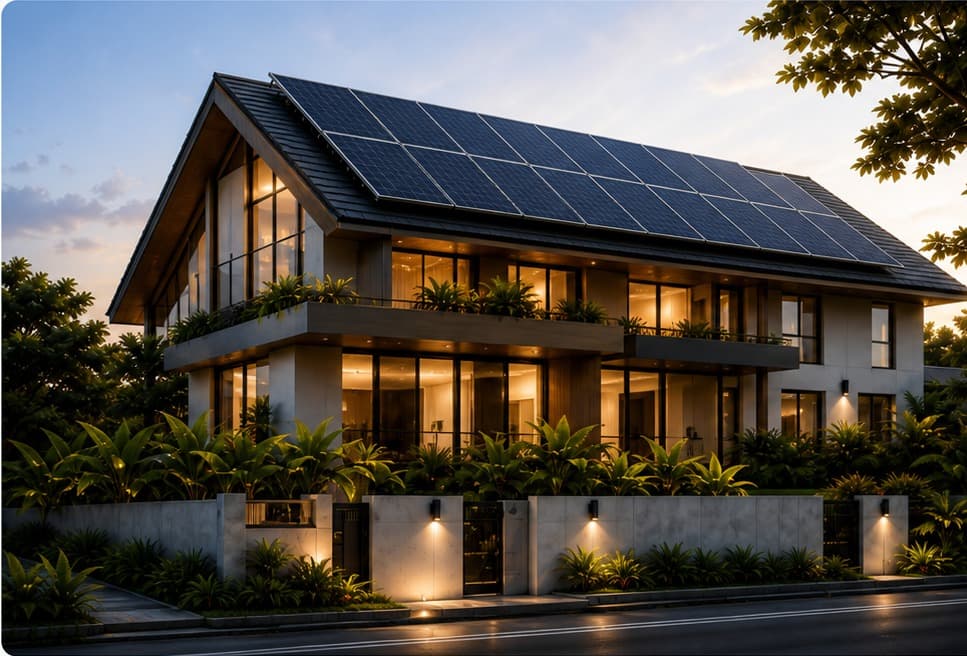
Heavy Aircon Terrace Homes Save S$4,400 a Year on Solar
Singapore landed homes with heavy aircon use get the fastest solar payback because self-consumption saves S$0.3478/kWh vs S$0.2581 from export.
Why should this article concern you?
- 1
S$0.3478/kWh saved every time your aircon runs from solar, not S$0.2581 from export
- 2
A 12kWp system with 3 aircon units and pool pump saves roughly S$4,400 per year
- 3
Every hour your aircon runs from the grid instead of solar is money you will not recover

The homes that benefit most from rooftop solar in Singapore are not the ones with the biggest roofs. They are the ones with the highest electricity bills, specifically the terrace houses and semi-detached homes running three or four aircon units through the afternoon heat. There is a number buried in this calculation that most installers do not put front and centre, and by the end of this guide you will see exactly why heavy aircon use flips the entire solar financial case in your favour.
Why the Tariff Gap Makes Aircon Homes Solar's Best Customers
Singapore's regulated electricity tariff sits at S$0.3478/kWh inclusive of 9% GST for Q3 2026, confirmed by the Energy Market Authority. The solar export credit, called the Solar Cogeneration Tariff, pays S$0.2581/kWh for surplus electricity you send back to the grid.
That gap of S$0.0897/kWh is the entire financial argument for sizing your system to match your aircon load. Every unit of solar electricity your aircon consumes directly saves you S$0.3478. Every unit you export instead earns only S$0.2581. Self-consumption is worth 34.8% more than export, unit for unit.
Peak Sun Meets Peak Cooling: The Timing Advantage
Singapore's solar irradiance peaks between 10am and 3pm, which is precisely when a typical landed home reaches its maximum cooling load. Singapore receives approximately 1,580 kWh/m²/year of solar irradiance (Sunnify estimate), with the sharpest generation window in the late morning through early afternoon.
If you run two to four aircon units through that five-hour window, you consume between 8 and 20 kWh during exactly the hours when solar output is highest. No battery required, no timing tricks needed. The sun and the cooling load align naturally.
Why 12-15kWp Beats 8kWp for Heavy Aircon Homes
An 8kWp system generates approximately 8,848 kWh per year using Singapore's benchmark of 1,106 kWh/kWp/year (Sunnify estimate, based on 4.33 sun-hours and 70% system efficiency). For your terrace house running three aircon units and a pool pump, that system saturates quickly and exports the surplus at the lower rate.
A 12kWp system generates approximately 13,272 kWh per year. With your terrace house pulling 15-18 kWh per day from solar during peak hours, self-consumption rises from a typical 25% to closer to 40-45%, because there is simply more load to absorb the generation. The savings arithmetic shifts dramatically in your favour at larger system sizes.
Inverter Aircon vs Conventional: One Pairs Better with Solar
Conventional fixed-speed aircon units draw a large spike of current at startup, then cycle on and off. Inverter aircon units run continuously at variable speeds, matching their power draw to the actual cooling demand. That variable-load profile pairs far better with solar generation, which also varies through the day as the sun angle changes.
If your terrace house runs inverter aircon, your solar panels and your cooling system modulate together through the day without the abrupt load spikes that can tip conventional units into drawing from the grid even when panels are producing. NEA's energy efficiency ratings show the latest 5-tick inverter units cut consumption by up to 40% compared to older fixed-speed models, stacking a second layer of savings on top of solar generation.
The Pool Pump Multiplier Most Homeowners Miss
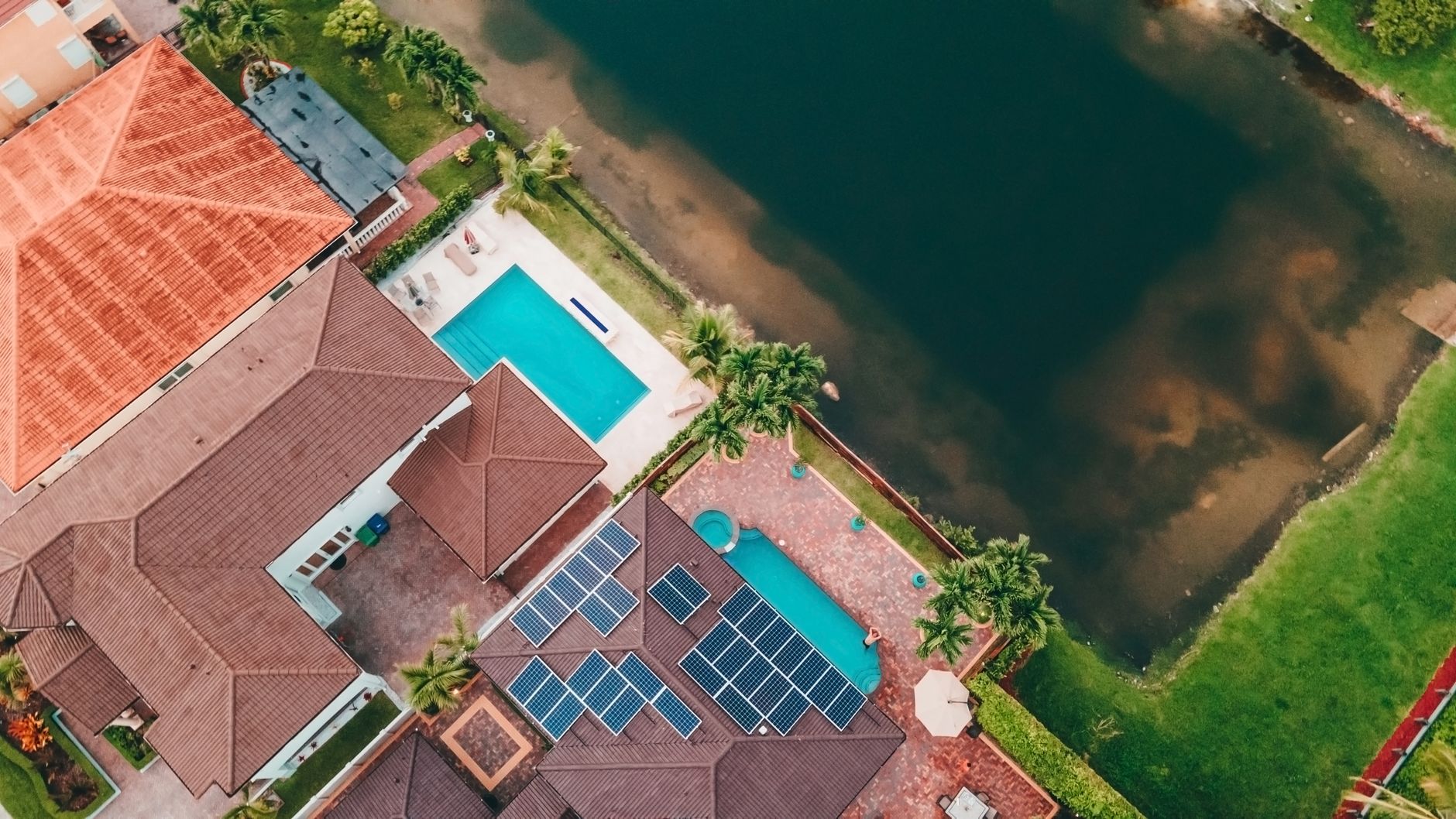
A standard swimming pool pump running 6-8 hours per day consumes between 3 and 5 kWh daily. Unlike aircon, which you might switch off at night, a pool pump runs on a timer through the daytime filtration cycle, making it an almost perfect solar load. Every day the pump runs from solar rather than the grid saves roughly S$1.04 to S$1.74 at the current tariff, adding up to S$380 to S$635 per year from the pump alone (Sunnify estimate).
If your pool pump has not been sized into your solar calculation, you are leaving a significant slice of savings on the table. The pump does not care whether it runs from solar or grid power. Your bill does.
Note: Pool pump consumption varies significantly by pump age, pool volume, and filtration cycle length. Confirm your actual load with a clamp meter before sizing your system, or ask your installer to include it in their shading and load analysis.
The Full Calculation: Three Aircon Units Plus Pool Pump, 12kWp System
Here is a concrete example for your terrace house. Three inverter aircon units averaging 1.5kW each running 8 hours per day, plus a pool pump drawing 0.5kW for 7 hours, gives a daytime solar load of approximately 39.5 kWh per day during peak season.
A 12kWp system generates around 36.4 kWh on a strong solar day, meaning virtually all generation is consumed directly during those hours. Annual generation from a 12kWp system: 13,272 kWh/year (Sunnify estimate). At a self-consumption ratio of 42% for a high-load home, that breaks down as follows.
- Self-consumed: 5,574 kWh saved at S$0.3478/kWh = S$1,938/year
- Exported: 7,698 kWh earned at S$0.2581/kWh = S$1,988/year
- Total annual value: S$3,926/year (Sunnify estimate)
Pool pump savings add another S$480/year at the conservative end, bringing the combined figure to approximately S$4,406/year. At a system cost of S$14,000 to S$18,000 for a quality 12kWp installation, payback lands between 3.2 and 4.1 years (Sunnify estimate). The system then generates freely for the remaining 21 years of its warranted life.
For the full picture on what solar installation costs in Singapore right now, the solar panel cost guide breaks down quotes by system size and installer tier.
Why Waiting Costs You More Than a Battery Does
When your aircon is running from solar, every degree of Singapore heat is working for your finances, not against them.
Most people assume solar payback is driven by panel size or roof orientation. For Singapore landed homes, it is driven by how much electricity you can consume during the solar generation window. Heavy aircon users are not the hardest case for solar , they are the easiest.
Your terrace house exporting 75% of its solar generation gets a good return. Your terrace house consuming 42% directly through aircon and a pool pump gets a significantly better one, because every kWh that stays on-site is valued at S$0.3478 rather than S$0.2581. The tariff gap is permanent and widens with every SP Group adjustment upward. Non-solar homes absorb every increase in full. Solar homes absorb none of it on the units their panels generate.
Each quarter you delay, the grid charges you for electricity your roof could have generated free. That cost does not disappear when you eventually install. It is simply gone. When you run your estimate on the Sunnify calculator, enter your actual aircon count and daily run hours, not the default values. The difference in projected savings will be significant, and it will tell you whether a 12kWp or 15kWp system is the sharper financial call for your specific terrace house.
Check whether your roof suits the system size you need with the roof suitability guide before you call an installer.
What does this mean for your home?
- Count your daytime loads before sizing. List every aircon unit, your pool pump if applicable, and any other appliances running between 10am and 3pm. That total load, not your roof size, determines the right system capacity for your terrace house.
- Size up, not down. For your terrace house with three or more aircon units, a 12-15kWp system captures far more value than an 8kWp system. The self-consumption rate rises with system size for high-load homes, pushing annual savings past S$4,000.
- Run your numbers now. Use the Sunnify solar estimate to see your specific savings based on your actual aircon count and run hours.
Does running aircon during the day actually reduce my solar payback period in Singapore?
Yes, significantly. Every kWh your aircon consumes directly from your solar panels saves you S$0.3478 at the current regulated tariff, compared to only S$0.2581 earned if that same unit is exported to the grid via the Solar Cogeneration Tariff. Your terrace house with heavy daytime aircon use will typically see self-consumption ratios of 40-45%, compared to 25% for lighter users, which shortens payback by 6 to 12 months on a typical 12kWp system. See the full ROI breakdown for worked examples at different consumption profiles.
How big a solar system do I need for a Singapore home with three aircon units and a pool?
Your terrace house running three inverter aircon units for 8 hours per day plus a pool pump for 7 hours draws roughly 39-40 kWh of daytime load on a typical Singapore day. A 12kWp system generating approximately 13,272 kWh per year (Sunnify estimate, based on EMA irradiance data) will cover most of that load during peak solar hours. A 15kWp system covers it more completely and is worth considering if your roof area allows it, as the incremental cost per kWp falls at larger system sizes and the additional generation is still well-utilised by your load profile.
More from Sunnify Solar Releases