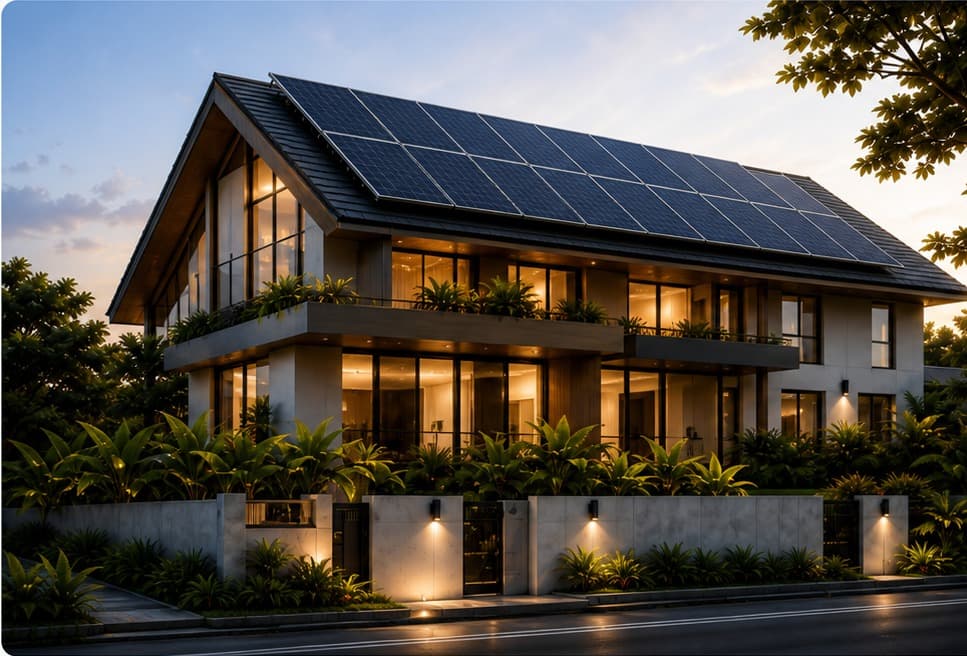
One Shaded Panel Costs Singapore Terrace Owners S$1,200 a Year
Shade from trees, neighbours, or tanks can gut your solar output. Here is how to identify the problem and fix it before it costs you thousands.
Why should this article concern you?
- 1
One shaded panel on a string inverter can cut your entire string output by 30 to 80 percent.
- 2
MLPE technology recovers up to S$1,200 per year in solar earnings on a shaded terrace house.
- 3
Skip the shading analysis now and lose that S$1,200 every year for the next 25 years.

A single branch from the angsana tree on your kerbside can quietly erase thousands of dollars from your solar returns every year. Shading on Singapore rooftops is the most underestimated threat to a system's performance, because most people do not discover it until they stare at their first quarterly generation report and wonder why the numbers look wrong. By the end of this guide, you will know exactly what is happening inside your panels when shade hits, and which solution closes the gap for your terrace house.
Why Shade Hits Singapore Rooftops Harder Than You Think
Singapore's solar irradiance is among the highest in Asia at 1,580 kWh/m²/year, according to the Energy Market Authority. That number assumes an unobstructed roof.
Three shading sources account for the vast majority of problems on Singapore landed homes. Roadside trees, particularly angsana and rain trees, are the most common culprit because their canopies spread laterally over fences and rooftops. Neighbour extensions, raised parapets, and party walls create fixed shadow bands that fall across roof planes at predictable times of day.
Rooftop clutter, including water tanks, television antennas, and air-conditioning condensers, creates localised obstruction that many people assume is too small to matter. It is not.
The reason shading matters so disproportionately comes down to how a standard string inverter works. Panels in a string behave like a chain: the weakest link sets the limit for everyone else. A single panel shaded to 30 percent of its rated output can pull an entire string of ten panels down to that same level, destroying up to 70 percent of the string's potential generation during that shading period.
This is not a fringe scenario. PV Tech documents string-level shade losses of 30 to 80 percent depending on string configuration and shading geometry. Your installer's sales pitch is built around full-sun performance. The gap between that pitch and your actual generation report is shade.
Key Finding
One shaded panel on a string inverter can cut your entire string output by 30 to 80 percent.
The Fix: Module-Level Power Electronics and When They Are Worth It
Module-level power electronics, or MLPE, solve the string problem by giving each panel its own power conversion. Two main technologies dominate the Singapore market. Microinverters, led by Enphase, convert DC to AC at each panel individually so a shaded panel affects only itself. DC optimisers condition each panel's DC output before it reaches a central string inverter, achieving a similar isolation effect at a slightly lower hardware cost.
Both approaches produce nearly identical results in real-world shading scenarios. The choice between them comes down to installer preference, warranty structure, and monitoring granularity, not performance.
The premium for MLPE over a standard string inverter system typically runs S$800 to S$1,800 for a 10 kWp terrace house installation (Sunnify estimate). That sounds like a meaningful addition to your system cost. Run the numbers and the picture changes fast.
A partially shaded 10 kWp system on a typical terrace house generates roughly 8,000 kWh per year with a string inverter, against a potential 11,060 kWh per year on an unobstructed roof. At a self-consumption rate of 25 percent valued at the current grid tariff of S$0.3478/kWh and export valued at the Solar Capacity Tariff rate of S$0.2581/kWh, that 3,060 kWh shortfall costs you approximately S$840 to S$1,200 per year in lost savings and export income (Sunnify estimate, depending on self-consumption profile).
At S$1,000 in lost annual value, the MLPE premium pays for itself inside two years. The inverter itself lasts at least 25 years.
Note: The 30 to 80 percent string loss range depends on string length, shade depth, and time of day, so ask your installer to run a site-specific shade analysis before assuming any figure.
The 10 Percent Rule and How to Apply It to Your Roof

The practical threshold is straightforward: if more than 10 percent of your usable roof area falls under shade at any point during peak sun hours, the financial case for MLPE is almost always positive. Below that threshold, a standard string inverter with careful string design, meaning shaded panels on a separate string, often performs nearly as well at lower cost.
Estimating your shading level starts with three free tools. Google's Project Sunroof covers parts of Singapore and shows irradiance variation across your roof face. The Solargis Prospect tool generates a shade map from satellite data for any Singapore address. The most reliable method remains a physical site survey, where a surveyor maps the sun's path against every obstruction on and around your roof.
A Sunnify site survey checks six specific items: kerbside tree height and canopy spread, neighbour parapet elevation relative to your roof ridge, water tank and antenna shadow cast at solar noon, roof pitch and orientation, available string configuration options, and whether any shading source is removable before installation. That last point matters more than most people expect. NParks and your town council both run formal pruning request processes for roadside trees, and a branch removal before you install can change your inverter specification entirely.
A Real Terrace: What the Numbers Actually Look Like
Take a typical 10 kWp system on a two-storey terrace house in Serangoon Gardens. The west-facing rear slope is clear. The east-facing front slope sits partially under an angsana canopy for roughly four hours each morning, shading three of eight panels on that string.
With a standard string inverter and all eight front panels on one string, morning generation on that string drops by approximately 60 percent during the shading window, costing roughly 2,800 kWh per year against the unshaded potential. Annual savings fall from a projected S$3,100 to approximately S$2,260, a gap of S$840 per year (Sunnify estimate using S$0.3478/kWh tariff and S$0.2581/kWh SCT export rate).
Fit DC optimisers on those eight front panels and isolate their performance: the three shaded panels operate at their actual shaded output without dragging the other five down. Annual generation on that slope recovers by approximately 2,200 kWh, adding back S$660 to S$700 per year in value. The optimiser premium of S$900 for those eight panels pays back in under two years, and the remaining 23 years of the system's life run at full east-slope potential.
When you install with the right inverter technology for your specific roof, shade stops being a problem you manage and becomes a problem that no longer exists.
The issue is never whether shade exists on your roof. Almost every Singapore terrace has some. The issue is whether your system is specified to handle it, or specified to pretend it does not. Those are two very different financial outcomes across a 25-year system life.
Your move is a site survey before you accept any quote. Any installer who does not offer a shade analysis is quoting you a best-case number that your terrace house roof will not deliver. When you run your numbers, use the Sunnify solar estimate tool and input a shading factor if your roof has visible obstructions. The calculator shows you how shading adjusts your payback period so you can see the MLPE premium in proper context.
For the full picture on whether solar makes sense for your terrace house given your specific roof conditions, the roof suitability guide walks through orientation, pitch, and shading together as a combined assessment.
What does this mean for your home?
- Request a shading analysis before signing any solar quote. If your installer does not map shade hour by hour across your roof, their generation estimate is optimistic by a margin that could cost you S$800 or more per year.
- If more than 10 percent of your roof falls under shade, specify MLPE. The premium of S$800 to S$1,800 typically pays back within two years at current tariff rates, and the remaining 23-plus years of system life run at full recoverable potential.
- Run the Sunnify solar estimate to see your specific numbers. Adjust the shading factor to match your terrace house roof and compare string inverter versus MLPE payback side by side.
Can trees blocking my solar panels in Singapore be removed or pruned?
NParks and your town council manage roadside trees in Singapore, and both bodies accept formal pruning requests from affected residents. Submit a request with photos showing the shading impact on your roof. The process takes weeks, not months, and a successful pruning can change your inverter specification and add hundreds of kilowatt-hours per year to your system. Private trees on neighbour land require a direct agreement with the neighbour. Always resolve or document tree shading before finalising your system design.
Are microinverters or DC optimisers better for a shaded Singapore rooftop?
Both achieve near-identical performance recovery in real-world shading scenarios. Enphase microinverters convert DC to AC at each panel individually and carry a 25-year warranty, making them a strong choice for long-term certainty. SolarEdge DC optimisers condition each panel's output before a central inverter and typically cost slightly less per panel. Your decision should rest on warranty terms, installer experience with each system, and monitoring features. See PV Magazine for independent MLPE testing data.
More from Sunnify Solar Releases