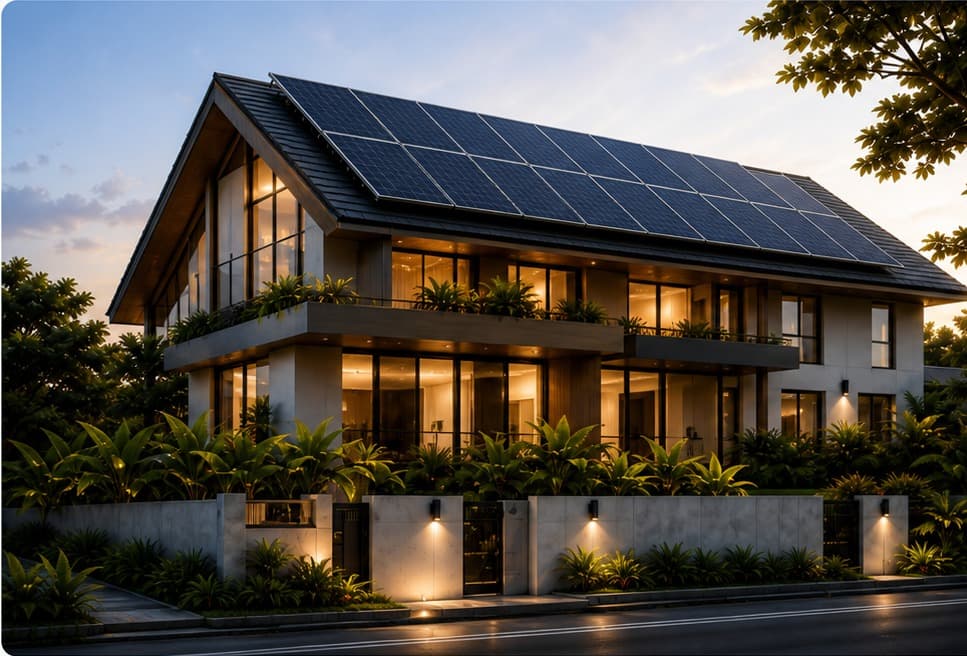
North-Facing Roofs Generate 92% of South-Facing Solar Output
Singapore's equatorial position means roof direction barely affects solar returns. A north-facing 10kWp system still earns S$2,940/year.
Why should this article concern you?
- 1
North-facing Singapore roofs generate 90-95% of south-facing output due to the equatorial sun path.
- 2
A 10kWp north-facing system earns roughly S$2,940/year, just S$160 less than south-facing.
- 3
Ignoring shade costs you S$15,500 over 25 years, far more than any orientation choice ever will.

Your installer just told you your best roof faces north and you are wondering whether to abandon the whole idea. Do not. Singapore sits at 1.3 degrees north of the equator, which changes almost every rule you have read about solar panel direction, and by the end of this guide you will understand exactly how many kilowatt-hours you are giving up , and why the shade from your neighbour's tree matters more than any compass reading.
Why Singapore's Latitude Rewrites the Orientation Rulebook
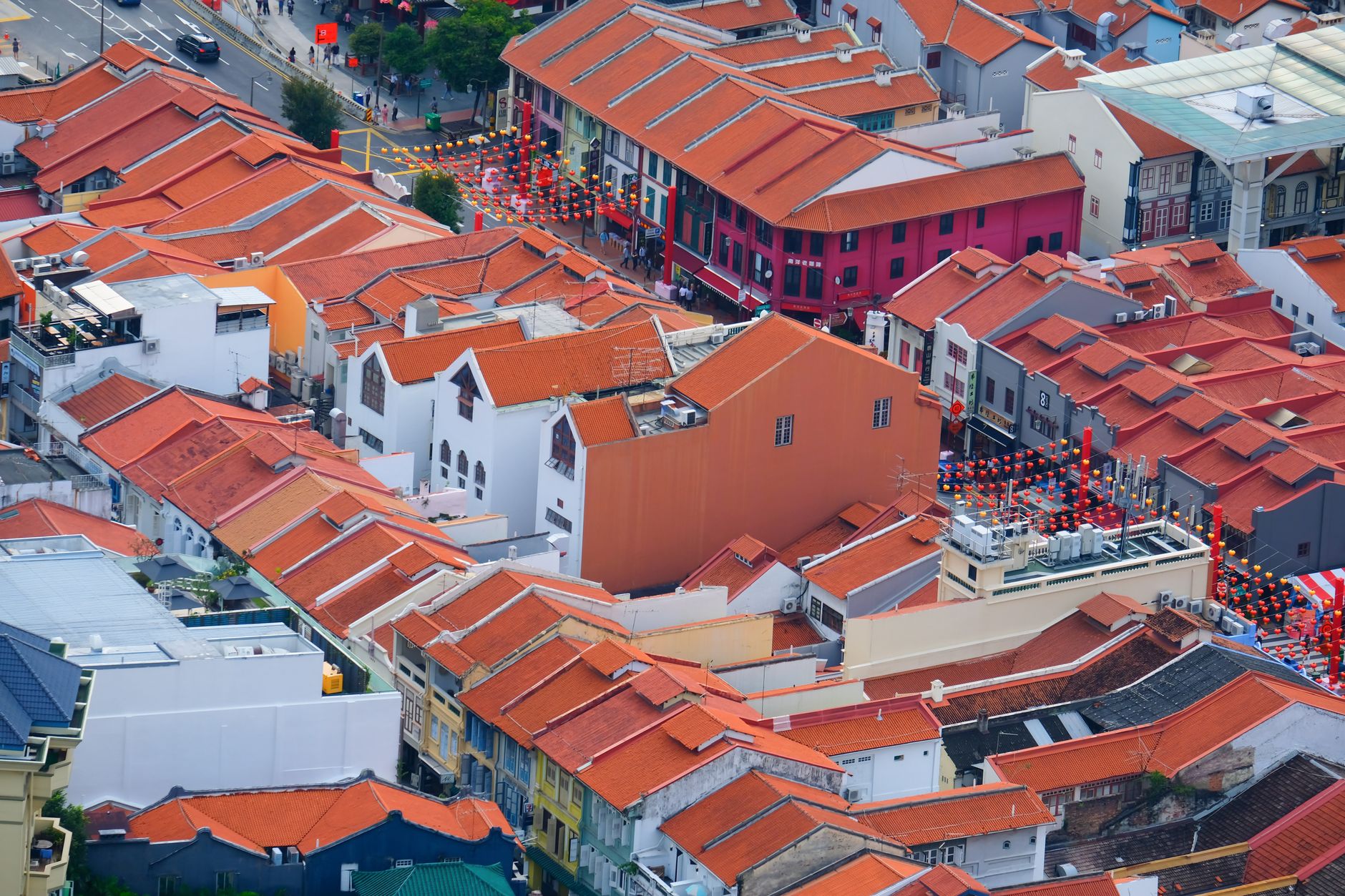
In the UK or southern Australia, the sun arcs decisively to one side of the sky all year. A north-facing roof in London generates roughly 70% of what a south-facing roof produces. That gap makes orientation a genuine make-or-break decision in temperate markets.
Singapore's sun behaves completely differently. Because the island straddles the equator, the sun passes almost directly overhead and crosses the zenith twice per year, once in April and once in September. Both your north-facing and south-facing roof slopes receive direct overhead irradiance for significant portions of the year.
EMA's Singapore solar irradiance data, available at EMA's website, supports the finding that a north-facing roof in Singapore generates approximately 90-95% of what a south-facing roof produces annually. That is not a rounding error. That is the single most important fact in this guide.
Key Finding
North-facing Singapore roofs generate 90-95% of south-facing output due to the equatorial sun path.
The Actual Kilowatt-Hour Difference on Your Terrace House Roof
Orientation differences are real but modest. Here is what the numbers look like for a 10kWp system on a Singapore terrace house, using 1,106 kWh/kWp/year as the Singapore generation baseline (Sunnify estimate, based on 4.33 peak sun hours daily and a 70% performance ratio).
A south-facing 10kWp system generates approximately 11,060 kWh/year. At 25% self-consumption and 75% export, that earns roughly S$3,100/year combining grid savings at S$0.3478/kWh and Solar Crediting Tariff (SCT) export credits at S$0.2581/kWh.
A north-facing 10kWp system at 92% of south-facing output generates approximately 10,175 kWh/year. The same consumption and export split yields roughly S$2,940/year. The annual gap is approximately S$160.
Over a 25-year panel lifespan, that orientation difference totals roughly S$4,000 in foregone income. That figure sounds large until you compare it to a fully shaded system losing 20% of output, which costs closer to S$15,500 over the same period. Direction is secondary. Shade is primary.
Note: These figures use Q3 2026 tariff and SCT rates. Confirm current SCT credits with your licensed solar retailer or at SP Group's website.
East-West Splits: The Self-Consumption Advantage
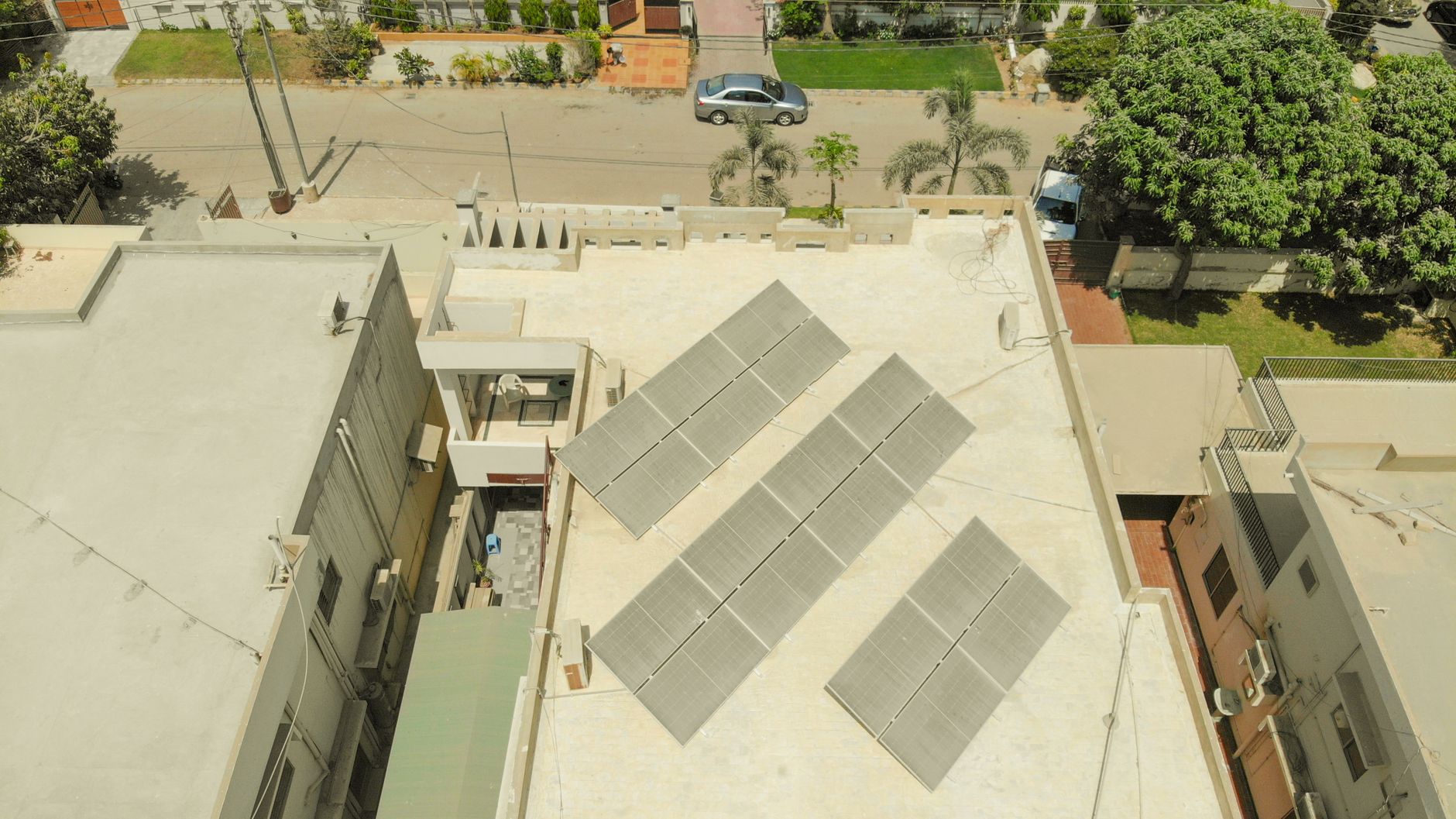
Many Singapore terrace houses have a dual-pitch roof running east-west rather than north-south. Splitting panels across both faces gives you a generation profile that is wider and flatter across the day rather than peaked at solar noon.
East-facing panels generate more electricity between 7am and 11am. West-facing panels peak between 1pm and 5pm. If someone is home in the mornings doing laundry, running the dishwasher, or charging an electric vehicle, east-facing panels match that load better than a purely south-facing array that peaks at noon when your terrace house may be empty.
Total annual generation from an east-west split is typically 5-8% lower than a south-facing array of the same capacity, according to PV Tech. But if the split raises your self-consumption ratio from 25% to 35%, the financial result improves significantly, because grid savings at S$0.3478/kWh are worth more than export credits at S$0.2581/kWh.
A 10kWp system with self-consumption rising from 25% to 35% earns an extra S$94/year in additional grid savings alone. That partially or fully offsets the generation loss from a non-ideal split. Your specific household schedule determines whether an east-west layout works in your favour.
Note: East-west annual income of approximately S$2,990/year is a Sunnify estimate. Your actual result depends on your consumption profile and roof dimensions.
Shading Costs You More Than Direction Ever Will
Shade is the silent killer of solar returns in Singapore's dense residential neighbourhoods. A neighbouring shophouse, a mature rain tree, a rooftop water tank, or even a TV aerial can clip your output far harder than pointing your panels in the wrong compass direction.
Standard string inverter systems are particularly vulnerable. When shade falls on even one panel in a string, the entire string's output drops to match the weakest panel. A single shaded panel in a 10-panel string can cut that string's output by 50-80% for the hours the shade persists. Modern microinverters or DC optimisers eliminate this problem by allowing each panel to operate independently, but they add roughly S$800-1,500 to the system cost.
The practical rule: if your south-facing roof is partially shaded and your north-facing roof is clear, the north-facing array will almost certainly outperform the shaded south-facing one. Clear sky beats compass every time. A shading analysis from your installer, using tools covered by PV Magazine, should be step one before any orientation discussion.
What to Do When Your Best Roof Faces North
Install anyway. The math supports it clearly. A 10kWp north-facing system in Singapore generating S$2,940/year still pays back a S$14,000 system in approximately 4.8 years, leaving over 20 years of near-free electricity generation ahead of you.
Three practical steps follow from this. First, get a shading assessment before an orientation assessment: confirm your north roof is actually shade-free before committing. Second, ask your installer to quote with microinverters or DC optimisers if any shading exists; the premium pays back faster than you expect. Third, check whether your roof area supports a slightly larger system to compensate for the modest output difference: going from 10kWp to 11kWp on a north-facing roof restores you to near south-facing equivalent output at marginal additional cost per kWp.
Singapore's sun crosses overhead twice a year. Your north roof is not a problem. It is just a roof that needs the right system design.
When you run your roof estimate, use the orientation input to see the exact kWh and S$ difference for your specific roof dimensions. The calculator applies Singapore-specific irradiance data, not generic global figures. You will see that the gap between orientations rarely justifies delaying installation by even a single quarter, because each quarter on the grid at S$0.3478/kWh is a quarter you do not get back.
You are not the one who spent six months researching the perfect orientation while paying full grid rates. Read through the full Singapore solar ROI breakdown to see the 25-year picture, and you will understand why direction is the last variable to optimise, not the first.
Your Move
When your panels go up this year, you will look at that north-facing roof slope not as a compromise but as the decision that started generating S$2,940/year while your neighbours were still debating compass bearings. The orientation question you came here with turns out to have a clear answer: get a shading report, size up by one kilowatt-peak if you want, and install. Every month you delay costs you roughly S$245 in grid electricity at S$0.3478/kWh you will never recover.
What does this mean for your home?
- Assess shade before orientation. Get a shading analysis of every viable roof face before deciding on panel placement: 20% shading costs more over 25 years than any compass direction.
- North-facing roofs are viable in Singapore. A 10kWp north-facing system generates 90-95% of south-facing output and still delivers roughly S$2,940/year in savings and export income on your terrace house.
- Run the numbers for your specific roof. Use the Sunnify solar estimate to see orientation-adjusted output and payback for your terrace house dimensions.
Does a north-facing roof make solar panels not worth it in Singapore?
No. Singapore's equatorial position at 1.3 degrees north means north-facing roofs receive direct overhead sun for significant portions of the year. A north-facing 10kWp system generates approximately 90-95% of what a south-facing system produces, translating to roughly S$2,940/year in savings and export income versus S$3,100 for south-facing. The annual gap of around S$160 does not change the investment case materially. See the full Singapore solar ROI guide for the 25-year numbers.
Should I choose an east-west or south-facing layout for my Singapore terrace house?
It depends on when your household consumes most electricity. A south-facing array peaks at solar noon, which suits terrace houses with midday loads. An east-west split spreads generation from morning to late afternoon, raising self-consumption if you are home in the mornings or evenings. Since grid savings (S$0.3478/kWh) exceed export credits (S$0.2581/kWh), a layout that raises your self-consumption ratio from 25% to 35% can offset the 5-8% generation loss from a non-ideal split. Ask your installer to model both scenarios against your actual consumption profile, or read the roof suitability guide for more detail.
More from Sunnify Solar Releases