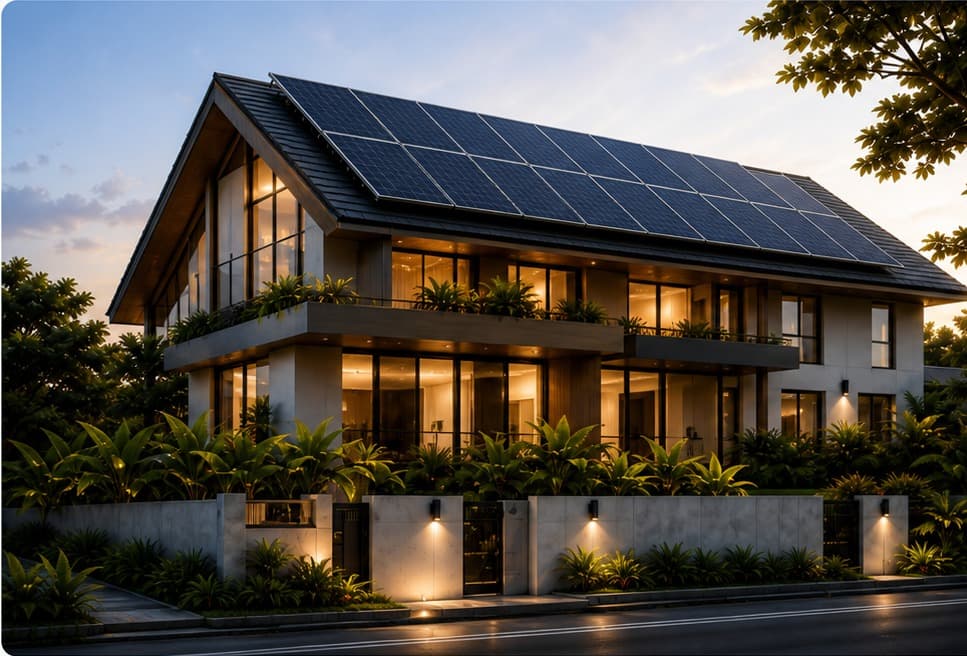
How Long Solar Panels Last in Singapore's Climate
Quality solar panels last 25 to 30 years in Singapore. Here is what the warranties cover, what the tropical climate does to your panels, and what to expect.
Why should this article concern you?
- 1
Quality solar panels carry a 25-year performance warranty and a 12-year product warranty as industry standard.
- 2
A 10kWp terrace house system earning S$3,100/year accumulates over S$77,500 across a 25-year lifespan.
- 3
Singapore's UV load never eases seasonally , panels here work harder year-round than in any temperate market.

A solar panel installed on a Singapore terrace house today will still be generating electricity when your kitchen appliances have been replaced three times over. The question is not whether quality panels survive the tropics. The question is how much they degrade across that lifespan, and whether your warranty actually protects you when something goes wrong. By the end of this guide, you will understand why Singapore's climate is harder on panels than most markets, and why that fact matters far less than the solar industry wants you to worry about.
What the Industry-Standard Warranties Actually Cover
Every reputable panel manufacturer ships two distinct warranties, and most homeowners only read one. The 12-year product warranty covers physical defects: delamination, cracked cells, frame corrosion, junction box failure. The 25-year linear performance warranty guarantees the panel generates a minimum percentage of its rated output at year 25, typically 80-84% of nameplate capacity.
Those two warranties protect different risks. Product warranties protect against manufacturing defects that show up within the first decade. Performance warranties protect against the slow, natural degradation of the photovoltaic cells across the panel's working life.
The degradation curve itself matters more than the headline number. Premium manufacturers, including those whose panels dominate Singapore installations, now specify 0.4-0.5% annual degradation, down from the older industry standard of 0.7%. At 0.5%/year, a panel rated at 400W produces 350W in year 25. At 0.4%/year, it produces 361W. That eleven-watt difference across a 10kWp system compounds into meaningful money over time.
Linear warranties are the key word to look for. Some older or lower-tier warranties use a stepped structure: a sharp drop in year one or two, then a slower decline. Linear warranties guarantee a consistent annual maximum degradation, giving you predictable output projections across the full 25-year window.
What Singapore's Climate Actually Does to Your Panels
Singapore sits at 1.37°N latitude, which means the sun never retreats the way it does in temperate markets. In Germany or Japan, panels get a seasonal rest: shorter days, lower sun angles, cooler temperatures for months at a time. Your terrace house roof in Singapore gets no such break. UV exposure, heat stress, and humidity operate at full intensity every single day of the year.
The four specific stressors that matter for Singapore are UV load, ambient temperature, humidity, and for coastal properties, salt-laden air.
UV load is the most underappreciated factor. Singapore receives approximately 1,580 kWh/m²/year of solar irradiance, according to EMA's irradiance data. That figure is among the highest of any major city in Asia. Sustained UV exposure causes EVA encapsulant browning over time, which reduces light transmission to the cells. Quality panels use UV-stabilised encapsulants specifically rated for tropical irradiance levels.
Cell temperature is the factor that most directly hits your daily output. Solar panels are rated at Standard Test Conditions of 25°C cell temperature. In Singapore, cell temperatures routinely reach 45-55°C on exposed rooftops. Every degree above STC reduces output by the panel's temperature coefficient, typically -0.35%/°C for PERC cells. At 45°C cell temperature, that is a 7% output reduction relative to the nameplate rating. This loss is already factored into the standard 30% system loss assumption that reputable installers use when sizing your system. The figure your installer quotes you in annual kWh already accounts for this.
Humidity creates two problems: it accelerates corrosion of metal components, and it creates the conditions for Potential-Induced Degradation, or PID. PID occurs when voltage differentials between the solar cell and the grounded frame drive ion migration through the encapsulant, progressively reducing cell efficiency. In high-humidity markets like Singapore, PID risk is meaningfully higher than in dry climates.
Note: PID risk is almost entirely mitigated by a quality inverter with built-in anti-PID circuitry and correct system grounding. Confirm your inverter model includes this feature before signing your installation contract. A list of certified inverters is maintained by EMA's solar PV licensing registry.
Salt air applies to properties within roughly two kilometres of the coast. Salt deposits on panel glass reduce light transmission and accelerate frame corrosion. Marine-grade anodised aluminium frames and anti-reflective coated glass with hydrophilic properties address this. If your terrace house is in Katong, Sembawang, or any coastal district, ask your installer specifically which panel models carry saltwater corrosion ratings.
How Panels Are Tested for Tropical Conditions
The baseline certification for all panels sold in Singapore is IEC 61215, the international standard for crystalline silicon terrestrial photovoltaic modules. This standard includes thermal cycling tests, humidity-freeze tests, and the test most relevant to Singapore: damp heat testing.
Damp heat testing exposes panels to 85°C temperature at 85% relative humidity for 1,000 hours. Panels that pass show no delamination, no significant power loss, and no corrosion of internal connections. It is the closest laboratory proxy for years of high-humidity tropical exposure.
IEC 61215 is necessary but not sufficient for Singapore conditions. Look for panels that also carry IEC 61730 safety certification and, for coastal properties, panels tested to salt mist corrosion standards. Some manufacturers additionally certify to IEC 62804, the specific standard for PID resistance. These certifications are verifiable on the manufacturer's datasheet and on the PV Tech technical database.
The damp heat test results across leading panel brands are publicly available in independent certification reports. A panel that passes at 1,000 hours with less than 2% power loss is demonstrably more suited to Singapore's humidity than one that scrapes through at the 5% loss threshold.
| Stressor | Singapore Severity | Effect on Panels | Mitigation |
|---|---|---|---|
| UV Load | 1,580 kWh/m²/yr - among the highest of any major Asian city | Browning of EVA encapsulant reduces light transmission to cells | UV-stabilised encapsulants rated for tropical irradiance levels |
| Cell Temperature | 45-55°C on exposed rooftops vs. 25°C STC rating | 7% output reduction at 45°C cell temperature (-0.35%/°C for PERC cells) | Factored into the standard 30% system loss assumption used at sizing |
| Humidity / PID | Year-round high humidity with no seasonal relief | Ion migration through encapsulant progressively reduces cell efficiency | Anti-PID inverter with built-in circuitry and correct system grounding |
| Salt Air | Properties within approx. 2 km of coast (Katong, Sembawang, coastal districts) | Salt deposits reduce light transmission; accelerates frame corrosion | Marine-grade anodised aluminium frames; IEC salt mist rated panels |
| All four stressors operate at full intensity year-round in Singapore. Quality panels carry a 25-year linear performance warranty guaranteeing 80-84% of nameplate capacity at year 25. | |||
Practical Lifespan in Singapore: What to Expect
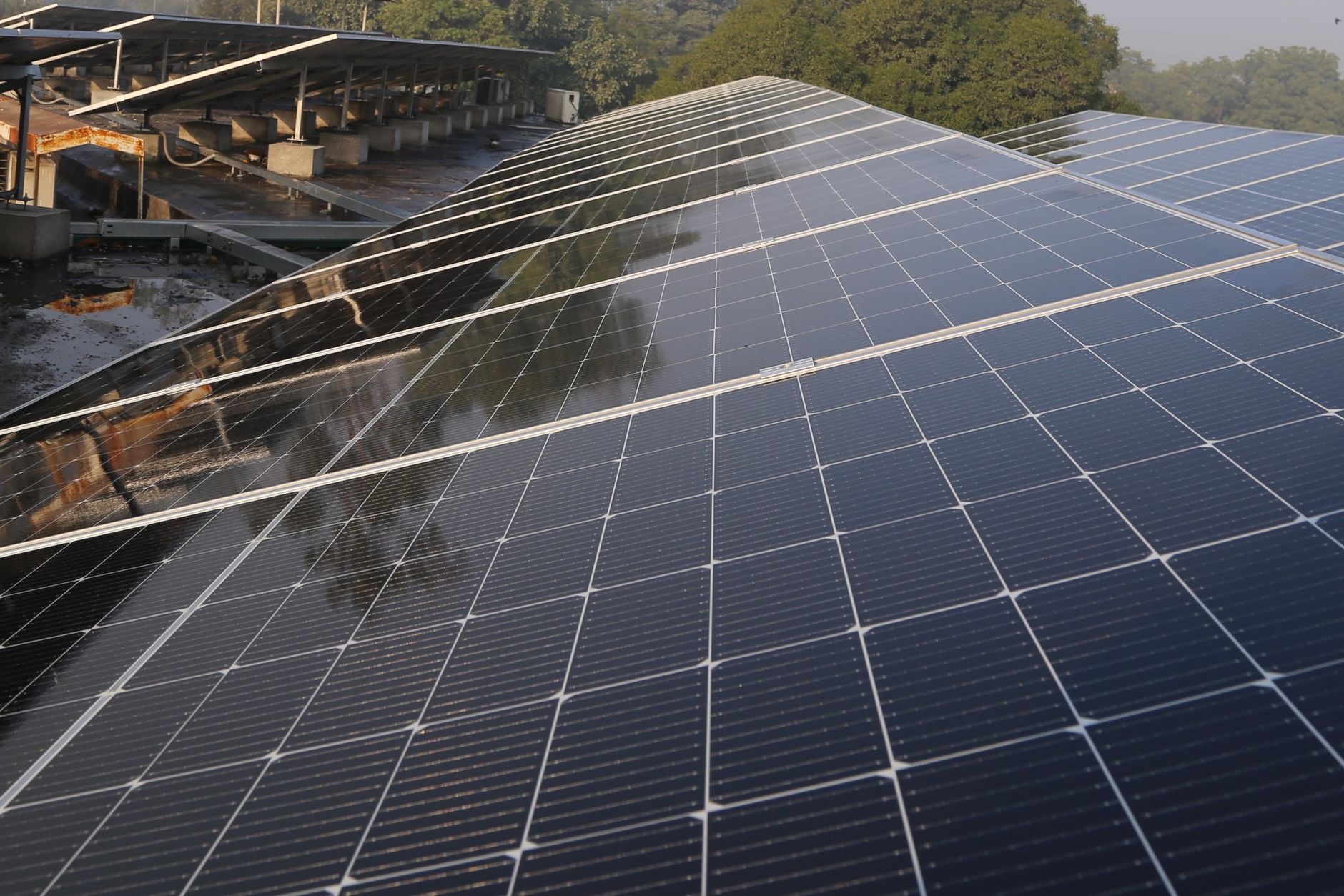
Quality panels from tier-one manufacturers installed correctly on a Singapore terrace house will generate electricity for 25 to 30 years. The 25-year window is not marketing language. It reflects the actual observed performance of silicon photovoltaic technology across two decades of real-world data in tropical markets.
The practical degradation picture for a well-specified Singapore system looks like this: year one typically sees a slightly larger drop, around 1-2% as cells stabilise, followed by the linear annual degradation rate of 0.4-0.5% thereafter. At year 25, your panels are still producing at roughly 80-84% of their original rated output, and the system keeps running.
Run the cumulative numbers on a 10kWp terrace house system at current rates. Annual generation of approximately 11,060 kWh, split between self-consumption savings at S$0.3478/kWh and export credits at S$0.2581/kWh, produces roughly S$3,100/year in combined value. Apply a conservative 0.5% annual degradation and that stream totals over S$72,000 across 25 years, before accounting for any tariff increases over that period.
The non-solar comparison is stark. At the current regulated tariff of S$0.3478/kWh, drawing those same 11,060 kWh/year entirely from the grid costs approximately S$3,846/year, or over S$96,000 across 25 years. Every tariff increase widens that gap further.
What Warranty Claims Actually Look Like
Most homeowners never file a warranty claim, because quality panels in correctly installed systems rarely fail within the warranty window. When claims do arise, they almost always fall into one of three categories: delamination visible as bubbling under the glass surface, hot spots detectable by infrared inspection, or junction box failure causing one string of panels to drop out entirely.
Filing a product warranty claim requires: a photograph documenting the defect, your original installation invoice, the panel serial numbers (recorded by any competent installer at commissioning), and a written fault description submitted to the manufacturer's regional office. Most tier-one manufacturers maintain Asia Pacific service offices in Singapore or operate through authorised local representatives who handle the paperwork.
Performance warranty claims are more complex. You need a certified power measurement report, typically from an EMA-accredited testing lab, showing that your system's output at measured irradiance levels falls below the warranted percentage. Your installer should be able to commission this test. The key practical point: keep your commissioning report, which records your system's actual output on day one. That baseline is what any future performance claim is measured against.
Manufacturer longevity matters here. A 25-year warranty is only as good as the company that issues it. Choose manufacturers with a Singapore or regional presence, an established global balance sheet, and a track record in Southeast Asian markets. When you run your estimate and compare installer quotes, ask each installer which panel manufacturer they specify and what the claims process looks like in practice.
When your panels are still running at year 25, the only question you will wish you had asked earlier is why you waited.
The honest picture is this: Singapore's climate is demanding but not exceptional for well-engineered silicon panels. The manufacturers who dominate global rooftop solar designed their products for markets including the Middle East, India, and Southeast Asia, where UV, heat, and humidity are facts of life rather than edge cases.
Tropical conditions become a meaningful risk only when you cut corners: on panel tier, on inverter quality, on installation workmanship, or on system grounding. A correctly specified system, installed by an EMA-licensed contractor, running a quality inverter with anti-PID circuitry, on a structurally sound roof, will perform close to its warranted output for the full 25-year window.
When you evaluate quotes, look at the full specification sheet: panel degradation rate, IEC certifications, inverter model, and installer track record. The solar panel cost guide breaks down what each component of your quote should cost and what to challenge. Panel durability in Singapore is not a reason to hesitate. It is a reason to specify correctly from the start.
What does this mean for your home?
- Specify IEC 61215 and IEC 62804 certification on every panel quote. Ask your installer to provide the datasheet showing damp heat test results and PID resistance rating before you sign.
- Record your commissioning output on day one. That baseline figure is the reference point for any performance warranty claim across the next 25 years. Request it in writing from your installer.
- Run the Sunnify solar estimate to see your specific numbers. Enter your terrace house size and see the 25-year value projection at current tariff rates.
How long do solar panels last in Singapore's tropical climate?
Quality panels from tier-one manufacturers last 25 to 30 years in Singapore conditions. The industry-standard 25-year linear performance warranty guarantees a minimum of 80-84% of original output at year 25. Singapore's constant UV load and high humidity are within the design envelope of panels certified to IEC 61215 damp heat standards. Correctly specified and installed systems consistently perform within warranted output ranges across their full lifespan. See the roof suitability guide for what else affects long-term performance.
Does Singapore's heat reduce how much electricity my solar panels produce?
Yes, but this reduction is already accounted for in every reputable installer's output estimate. Standard Test Conditions rate panels at 25°C cell temperature. Singapore rooftop cells typically reach 45-55°C, which reduces output by approximately 7% via the temperature coefficient of -0.35%/°C for PERC panels. Reputable installers apply a standard 30% system loss factor that includes this temperature derating, so the annual kWh figure you are quoted already reflects real Singapore operating conditions. If an installer does not mention system losses in their proposal, ask them directly which loss factor they applied.
More from Sunnify Solar Releases