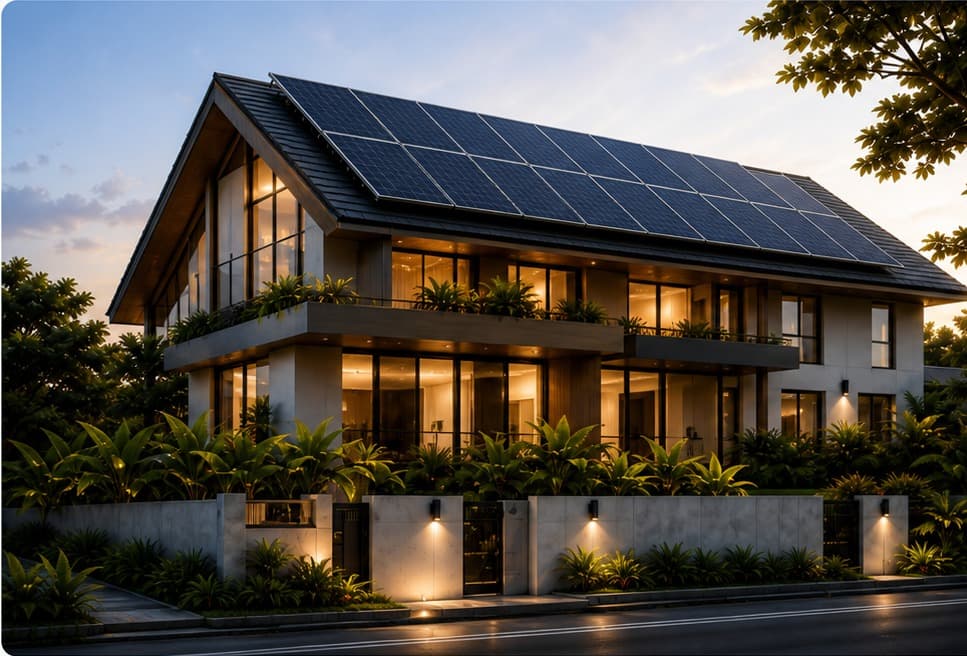
10kWp Terrace House Earns S$72,000 Over 25 Solar Years
Solar panels lose 0.5% output per year. Here is exactly what that means for your Singapore terrace house over 25 years.
Why should this article concern you?
- 1
0.5% annual degradation means your 10kWp system still delivers 88% output at year 25
- 2
A Singapore terrace house accumulates S$72,000 in savings over 25 years despite degradation
- 3
Every year without solar locks in grid prices on 100% of your consumption, permanently

Your solar panels will produce less electricity in year 25 than they do in year 1. That is not a defect. Every panel on every roof in Singapore degrades, and the question is not whether it happens but whether it changes the financial case. By the end of this guide, you will see the exact production numbers across the full 25-year life of a typical terrace house system, and the answer will not be what most people expect.
The 0.5% Rule: What the Industry Standard Actually Means

Panel degradation is the gradual reduction in a solar cell's output caused by UV exposure, thermal cycling, and moisture. PV Tech's industry analysis confirms the consensus figure: quality monocrystalline panels degrade at roughly 0.5% per year. After 25 years, your system still produces 88% of its original rated output.
Apply that to a 10kWp terrace house system in Singapore, using the local peak sun hours of 4.33 hours per day. Year 1 generation lands at approximately 11,060 kWh.
Year 25 generation, after 24 compounding steps of 0.5% degradation, falls to approximately 9,808 kWh. The difference across the full 25 years is real but far smaller than the savings gap between owning solar and not owning it.
How Degradation Moves Your Payback Period
Most simplified payback calculators assume flat output every year. That underestimates payback slightly, because year 3 and year 4 produce marginally less than year 1. The honest number adjusts for this curve, and the effect is modest: degradation typically extends a 4.0-year simple payback to roughly 4.2 years on a degradation-adjusted basis. The Sunnify solar estimate calculator already factors in the 0.5% annual degradation rate, so the payback figure you see there is the honest, compounding number.
The reason degradation barely moves the payback figure is straightforward. Your heaviest financial lifting happens in years 1 through 6, when output is at its highest and every kWh saved or exported is worth the most. By the time production has visibly declined, the system has long since paid for itself.
At the current regulated tariff of S$0.3478/kWh (inclusive of 9% GST, effective Q3 2026 per EMA) and the S$0.2581/kWh SCT export credit, a 10kWp system with 25% self-consumption generates approximately S$3,100 per year in combined savings and export income in year 1 (Sunnify estimate). By year 25, that annual figure has fallen to roughly S$2,728 due to degradation alone. The cumulative 25-year value, even ignoring any tariff increases, sits near S$72,000.
Note: These figures use the Q3 2026 tariff and current SCT export rate. EMA reviews both quarterly. Confirm current rates at SP Group before finalising your estimate.
Monocrystalline vs Polycrystalline: Why It Matters at Year 20
Monocrystalline panels, now the dominant technology in Singapore residential installations, carry a real-world degradation rate of 0.3% to 0.5% per year. Polycrystalline panels, increasingly rare in new installations, degrade at 0.5% to 0.8% per year.
Over 25 years, the difference compounds: a monocrystalline system at 0.3% retains 93% of rated output at year 25, while a polycrystalline system at 0.8% retains only 82%. If your roof has panels installed before 2018, verify the cell type before assuming the 0.5% standard applies.
The practical consequence is visible in warranty terms. Premium monocrystalline manufacturers such as LONGi and Jinko Solar publish linear degradation warranties guaranteeing no more than 0.55% per year with a floor of 80–84.8% output at year 25, per their published product documentation at PV Magazine.
Older or lower-tier panels often use stepped warranties that guarantee 90% at year 10 and 80% at year 25, without protecting the rate of decline in between. Linear is the standard worth holding out for.
Year 20 Decision: Replace or Keep Running?
At year 20, your monocrystalline system is producing roughly 90% of its year-1 output. The inverter, which typically carries a 10-to-15-year warranty, may already have been replaced once.
The panels themselves still have five or more years of warranted life remaining. Replacing functional panels at year 20 almost never makes financial sense: the cost of a new system is not recovered in the five-year remaining warranty window at 90%–88% output.
The scenario that changes the calculation is a step-change in panel efficiency that dramatically lowers cost per watt. That has not happened in a single five-year window in the industry's history, and IEA's solar PV outlook projects continued incremental gains rather than step-changes. Keep running the existing system and revisit the decision at year 25 when warranty obligations end and true end-of-life begins.
The more productive question at year 20 is whether to add a battery storage system, which pairs with your now-paid-off panels and shifts your export kWh to evening self-consumption. Explore the export and storage options for Singapore landed homes for a full breakdown of that calculation.
Your 25-Year Picture, Honestly Framed
The grid does not give you a degradation discount. Every year you delay, you pay full price on every unit you consume.
Return to the hint from the opening: degradation does change the numbers, but not in the direction most people expect. The instinct is to worry that declining output undermines the financial case. The math says the opposite.
A system that still produces 88% of its rated output in year 25 is a system that has already returned every dollar of its cost many times over. The degradation curve matters for precise payback modelling. It does not matter for the go-or-no-go decision.
When you run your estimate, look at the 25-year cumulative savings figure before you look at the payback period. A 10kWp terrace house system at current tariffs accumulates approximately S$72,000 in savings over 25 years (Sunnify estimate, degradation-adjusted, no tariff inflation assumed). That figure sits against a system cost of S$10,000 to S$16,000. The return is not close.
Each year without solar is a year where your terrace house draws entirely from the grid at the regulated tariff, with no offset and no export income. That gap does not close retroactively when you eventually install. When you look back from year 5 with a system that has already covered its cost, the panels you did not install in year 1 represent five years of full-price grid consumption you can never recover. See the full ROI breakdown for Singapore landed homes to frame the complete picture before your installer visit.
What does this mean for your home?
- Insist on a linear degradation warranty, not a stepped one. When comparing installer quotes, ask for the panel's warranted annual degradation rate. A linear warranty guaranteeing no more than 0.55% per year is the standard worth requiring for any new installation.
- At year 20, your default position is to keep running. Unless a step-change in panel cost and efficiency makes early replacement financially clear, a system producing 90% of rated output with no remaining debt is an asset, not a liability. Replace the inverter if needed and run the panels to year 25.
- See your exact 25-year degradation-adjusted figure. Run the Sunnify solar estimate to see your specific numbers, with the 0.5% annual degradation curve already built into the payback and cumulative savings calculation.
Does solar panel degradation significantly affect my payback period in Singapore?
The effect is real but small. At the standard 0.5% per year degradation rate, a typical Singapore terrace house system sees its payback period extend by roughly 0.1 to 0.2 years compared to a flat-output assumption. The Sunnify calculator already applies the degradation curve, so the payback figure it returns is already adjusted. See the full ROI breakdown for a detailed walkthrough of the calculation.
Are solar panels still worth it in Singapore after 20 years of degradation?
At year 20, a quality monocrystalline system still produces approximately 90% of its year-1 rated output. Since the system typically pays back its cost within 4.0 to 4.2 years, the remaining 15 to 20 years of output are effectively free electricity. EMA's energy statistics show Singapore's grid tariff has trended upward over time, which means the value of that degraded-but-still-generating output grows, not shrinks, as the years pass.
More from Sunnify Solar Releases