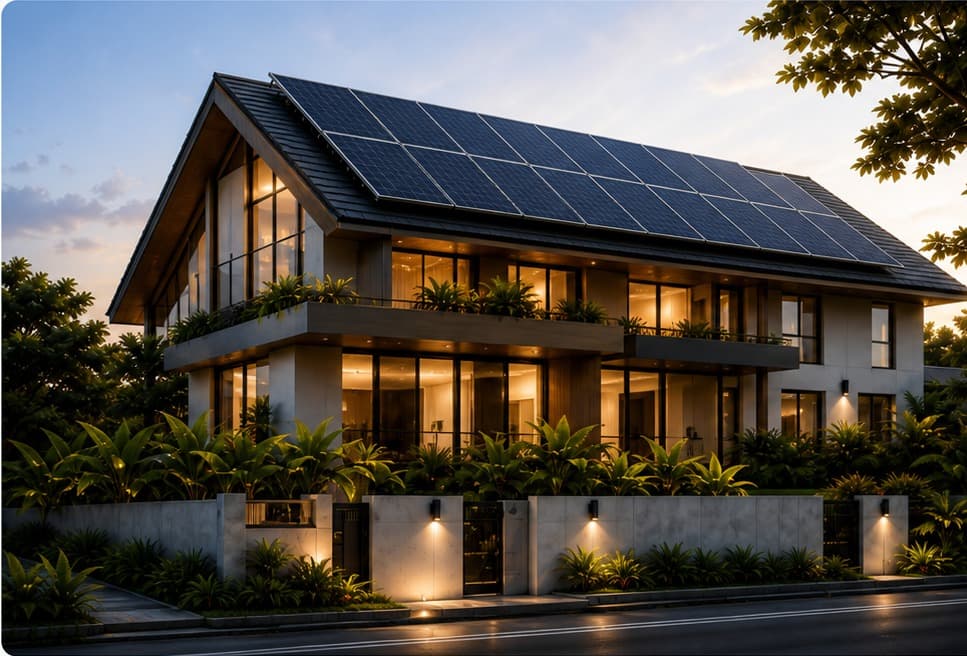
10kWp Solar System Adds S$3,100 a Year at Resale
How to transfer your SP Group solar agreement, document annual savings, and present your system as a yield asset when selling your terrace house.
Why should this article concern you?
- 1
A 10kWp system generates a documented S$3,100/year that transfers to your buyer on settlement day.
- 2
Framing solar as S$3,100/year in verified yield means buyers calculate their own return within seconds.
- 3
Buyers who skip your solar terrace house will pay full grid tariff from day one, losing years of savings they cannot recover.

Most Singapore homeowners install solar, enjoy five years of lower bills, then panic the moment they decide to sell. The fear that panels will scare buyers, complicate the transaction, or get stripped off at cost is understandable , and entirely wrong. There is one detail about what happens to your system's financial record at the point of sale that changes how every serious buyer will see your terrace house, and this guide lays it out in full.
What Solar Actually Does to Your Property's Market Value

Singapore does not yet have a large enough transaction dataset to produce a statistically verified solar premium figure the way the US or Australia does. What the market does show is that a system generating S$3,100 to S$4,656 a year in grid savings and export credits creates a quantifiable yield that buyers can underwrite, and yield-minded buyers respond to yield.
A 10kWp system on a typical terrace house generates roughly 11,060 kWh per year at Singapore's irradiance. At the current regulated tariff of S$0.3478/kWh inclusive of GST, that translates to roughly S$961 in self-consumption savings plus S$2,142 in export credits at the EMA's Solar Crediting Tariff of S$0.2581/kWh (Sunnify estimate based on 25% self-consumption and 75% export). That is not a lifestyle feature. That is a documented income stream your buyer inherits.
The framing matters enormously. When your agent lists solar as a bullet point alongside "granite countertops" and "timber flooring", they waste it. Position the system by its annual S$ output and the buyer calculates their own payback within seconds.
Key Finding
A 10kWp system generates a documented S$3,100/year that transfers to your buyer on settlement day.
How to Transfer the SP Group Solar Agreement to Your Buyer
The solar agreement with SP Group does not automatically follow the property. You need to initiate a transfer, and the process has a sequence that must happen before the completion date.
First, notify SP Group in writing that the property is being sold and request the relevant transfer forms. Second, your buyer completes their own SP Group account setup and GIRO authorisation for any future standing charges.
Third, the Licensed Electrical Worker (LEW) who originally commissioned the system issues a sign-off confirming the installation remains compliant with EMA electrical licensing requirements. Fourth, SP Group processes the new metering account under the buyer's name, typically within two to four weeks of receiving all documents.
Start this process at least six weeks before your expected completion date. Waiting until after you have exchanged contracts creates unnecessary pressure and can delay your buyer's first export credit payment by a full billing cycle.
The Four Documents Every Solar Buyer Will Ask For
A prepared seller closes faster. Have these four documents ready before your first viewing.
The LEW sign-off certificate proves the installation met Singapore's electrical safety standards at commissioning. Without it, your buyer's own electrician will need to re-inspect at your cost.
The SP Group GIRO letter confirms the export metering account is active and shows your buyer exactly what credit rate applies. The panel and inverter warranty documents matter because most reputable panel manufacturers offer transferable 25-year product and performance warranties , check yours, as Jinko, Longi, and Canadian Solar all allow transfer to a new owner with written notification to the manufacturer.
Inverter warranties vary by brand and are typically 10 years, extendable. The system commissioning report your installer produced at handover shows actual measured output versus designed output and gives your buyer independent confidence in the system's condition.
Note: Warranty transferability terms vary by manufacturer. Confirm the exact process for your specific panel brand with your original installer before marketing the property.
Presenting Solar as a Savings Asset, Not a Feature List

The language your agent uses in the listing controls whether solar becomes a value driver or a source of buyer hesitation. One sentence does it: "Solar system generating approximately S$3,100/year in electricity savings and export credits, fully transferable, documentation provided."
That sentence gives buyers a number, a verb (generating), a timeframe (per year), and a reassurance (fully transferable). Compare it to "solar panels installed" and you see why the framing determines whether a buyer mentally adds or subtracts value , give your agent the annual S$ figure and insist they use it in the listing, not buried in a footnote.
For viewings, print a one-page summary showing the system size, last 12 months of SP Group export credit statements, the annual saving at the current tariff, and the warranty expiry dates. Buyers comparing your terrace house to an identical one without solar will feel the difference between a vague claim and a documented yield.
What Happens If the Buyer Does Not Want the Solar System
Removal of a rooftop solar system is not trivial. Panel removal, inverter decommissioning, roof penetration patching, and SP Group metering reversal typically cost S$3,000 to S$6,000 depending on system size and roof type (Sunnify estimate). That cost falls on whoever agrees to bear it in the Option to Purchase.
In most cases, a buyer who initially resists solar changes position once they see the annual savings figure and understand the system transfers with full warranties intact. If the buyer genuinely does not want it, the more useful negotiation is to price the removal cost into the final sale figure rather than actually removing working equipment.
A system generating S$3,100/year with 20 years of warranty life remaining has a discounted present value well above its removal cost. Most buyers, once they see that arithmetic, elect to keep it.
When your buyer sees S$3,100 a year landing in their account from day one, the solar system stops being a complication and starts being the reason they chose your house.
Closing the Loop: Your Move Before You List
The insight most sellers miss is that solar's value at sale is not about the panels on the roof , the yield is the value. Every year of export credits and grid savings is a documented return that transfers to your buyer alongside the title deed, and your panels have been quietly building a provable financial record while you lived there.
Gather your SP Group statements for the last 12 months and calculate the actual annual credit received. That figure, compared to the current tariff of S$0.3478/kWh, gives you a real-world savings number that no buyer can dispute.
Present that number in your listing, in your viewings, and in your agent's briefing. The gap between your solar terrace house and an identical non-solar home is not cosmetic , your buyer steps into savings from the moment they collect the keys, while the buyer next door starts paying full grid tariff on every kilowatt-hour from day one.
When you run your system's current numbers before setting your asking price, use the Sunnify solar estimate tool to generate an annual savings figure based on your actual system size. For a deeper look at the full ROI over 25 years, see whether solar is worth it for Singapore landed homes. Your buyer will be looking at a terrace house that pays them back from the first bill , that is the number that closes the deal.
What does this mean for your home?
- Gather your SP Group export statements now. Twelve months of statements gives you a documented annual yield figure that anchors your listing price with real data, not estimates.
- Start the SP Group transfer process six weeks before completion. Delays in metering transfer mean your buyer loses their first billing cycle of export credits and you inherit the friction at the worst possible time.
- Run your current annual savings figure before you set your asking price. See exactly what yield your system is generating with the Sunnify solar estimate, then give that number to your agent in writing.
Do solar panels increase property value in Singapore?
Singapore does not yet have a large enough solar transaction dataset to publish a statistically verified price premium, but a system generating S$3,100 to S$4,656 per year in documented savings and export credits creates a measurable yield that value-conscious buyers can underwrite directly. The practical impact depends on how well you present the annual S$ figure rather than the panels themselves. For a full breakdown of the financial case, see whether solar is worth it in Singapore.
How do I transfer my SP Group solar agreement when I sell my house?
Notify SP Group in writing as soon as your property is under offer and request the transfer forms. Your buyer completes their own GIRO authorisation, your original LEW issues a compliance sign-off confirming the installation still meets EMA electrical licensing requirements, and SP Group processes the new metering account , typically within two to four weeks of receiving all documents. Allow at least six weeks before your completion date to avoid billing disruption.
More from Sunnify Solar Releases