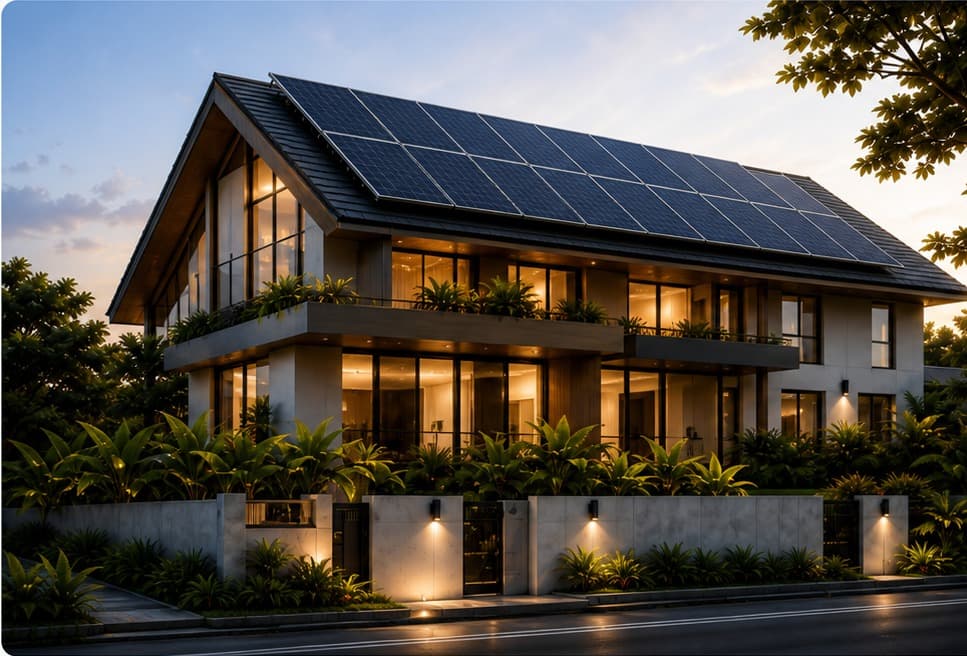
10kWp Solar Cuts Your SP Bill by 88 Percent
A line-by-line walkthrough of how a Singapore SP Group electricity bill changes after rooftop solar, with real before-and-after figures.
Why should this article concern you?
- 1
A 10kWp system cuts a S$278/month SP Group bill to roughly S$30-S$40/month, saving S$3,100/year.
- 2
Your SCT export credit of S$0.2581/kWh earns S$178/month on 691 kWh exported, offsetting your grid charge.
- 3
Each month without solar locks in full grid rates at S$0.3478/kWh while your payback clock runs.

Your SP Group bill does not disappear when you go solar. It shrinks, it changes shape, and one new line appears that most people never expected to see: a credit. Understanding what happens to each line item is the single most practical thing you can do before signing a solar contract, because it tells you exactly what you are buying and when you get your money back.
What a Singapore Landed Home Pays Before Solar
A landed home in Singapore typically consumes between 800 kWh and 1,200 kWh per month, depending on air-conditioning use, household size, and whether you work from home. At the current regulated tariff of S$0.3478/kWh inclusive of 9% GST, that translates to a monthly bill of S$278 to S$417.
That number is not one charge. Your SP Group bill bundles four components into a single per-kWh rate, and each one behaves differently once solar is on your roof.
Anatomy of Your SP Group Bill: Four Lines, One Rate
The consumption charge covers the wholesale cost of electricity SP Group purchases on your behalf. The fuel cost component is a pass-through for natural gas prices, which fluctuate quarterly , it is the main reason your tariff shifts every three months as published by the Energy Market Authority.
The Market Support Services Levy funds the Singapore electricity market infrastructure. GST at 9% sits on top of all three.
Solar touches only what you draw from the grid. Every kWh your panels generate and you consume yourself never hits any of those four lines.
How Solar Changes Each Line on Your Bill
Take a terrace house consuming 800 kWh/month. A 10kWp system in Singapore generates roughly 922 kWh/month on average (1,106 kWh/kWp/year divided by 12 months, per EMA irradiance data).
With a typical self-consumption ratio of 25%, your panels cover 231 kWh/month of your own load directly. The remaining 691 kWh/month exports to the grid.
Your grid draw drops from 800 kWh to 569 kWh/month. Every one of those four bill components applies only to those 569 kWh, not the original 800.
Note: Self-consumption ratio varies by household routine. Daytime workers at home, pool pumps, and EV charging all push this figure higher. Confirm your expected ratio with your installer before finalising projections.
The New Line That Appears: Your SCT Credit
When you register under the Solar Generation Scheme, SP Group adds a Solar Credit Transfer (SCT) line to your bill. The current SCT rate is S$0.2581/kWh, applied to every kWh your system exports.
On our example terrace house exporting 691 kWh/month, that credit is S$178/month. SP Group nets this against your remaining grid consumption charge before you pay anything.
A Real Before-and-After Bill: 10kWp System, 800 kWh/Month
Before solar, your bill is 800 kWh × S$0.3478 = S$278.24/month. After a 10kWp system installs, your grid draw falls to 569 kWh, costing S$197.90/month.
Your SCT credit for 691 kWh of export is S$178.35/month. Net bill: approximately S$19.55/month for grid electricity.
Add the fixed grid connection charge, which SP Group levies on all premises regardless of solar status, and your total monthly outgoing sits around S$30 to S$40, depending on your connection type. Your bill has not vanished , it has dropped by roughly 88%.
Why Your Bill Is Never Zero

Three things guarantee a residual bill. First, the grid connection charge is a fixed monthly fee for maintaining your physical link to the SP network. Second, your panels produce nothing at night, so every kWh you use after sundown comes from the grid at the full tariff.
Third, overcast days, especially during the northeast monsoon from November to January, cut generation significantly. Singapore does not yet have widespread residential battery storage that would let you shift solar generation into evening hours at any scale.
How to Track Generation vs Consumption in the SP App
SP Group's app displays your smart meter data in near real-time once your system is registered. You will see a consumption graph alongside your solar generation data if your installer has linked the system correctly.
The figure to watch is the net import line, which shows exactly how many kWh you are still drawing from the grid each day. Cross-check this against your inverter monitoring app , Sungrow's iSolarCloud, SolarEdge's mySolarEdge, or whichever platform your installer uses.
If your inverter reports 30 kWh generated on a given day and your SP meter shows 22 kWh imported, you consumed 52 kWh total that day, with 8 kWh of self-consumption. That ratio tells you whether your system is sized correctly for your lifestyle.
GIRO Solar Credits: Monthly vs Quarterly Settlement
Your SCT credit appears on every monthly SP bill. If the credit exceeds your grid consumption charge in any given month, SP Group carries the surplus forward as a credit balance rather than paying it out immediately.
SP Group settles accumulated credits quarterly, typically by crediting your GIRO account or issuing a cheque. For most landed homeowners on a 10kWp or larger system, the export credit runs close to or slightly above the residual grid bill in peak solar months (March to October).
In the monsoon months, the balance tips the other way and you draw from any accumulated credit. See how export credits work in Singapore for the full settlement mechanics.
When you see that SCT credit line for the first time, you will understand exactly what solar ownership feels like: the grid pays you.
Your Terrace House Returns S$3,100 a Year at Current Rates
Annually, the example above cuts roughly S$248/month from your outgoings on average, or S$2,976/year in reduced grid charges. A Sunnify estimate for the same setup, incorporating the full export credit, puts total annual savings at approximately S$3,100/year (self-consumption savings of S$961/year plus export income of S$2,142/year).
Over 10 years, that is more than S$31,000 returned from a system that cost between S$10,000 and S$16,000 to install.
Payback on this scenario sits between 3.2 and 5.2 years, leaving you with 20 or more years of net positive cashflow before your panels reach end of warranty life. When you run your estimate, use your actual monthly kWh consumption from your SP app to sharpen the self-consumption ratio and get an accurate payback figure for your specific roof.
S$3,100 a year is what a 10kWp system returns on an 800 kWh/month landed home in Singapore at current tariff and SCT rates. Every line item on your SP Group bill either drops or generates a credit.
Read the full breakdown of whether solar is worth it for Singapore landed homes if you want the 25-year scenario modelled with panel degradation and tariff escalation built in.
What does this mean for your home?
- Pull your last three SP bills and note your average monthly kWh. This single number determines your self-consumption ratio and your export volume, which together set your actual annual saving, not a generic estimate.
- Register under the Solar Generation Scheme before your installer connects your system. Without SCT registration, your export earns nothing and your bill savings are limited to self-consumed units only, cutting projected returns by more than half.
- When your system is live, you will watch that SCT credit line appear and your bill shrink by 88% , run the Sunnify solar estimate now to see exactly what your terrace house numbers look like before you sign anything.
Will my SP Group electricity bill go to zero after installing solar panels?
No. Fixed grid connection charges apply to all premises regardless of solar, and any electricity you draw at night or during low-generation periods is billed at the standard tariff of S$0.3478/kWh. Most 10kWp systems on Singapore landed homes reduce monthly bills by 80-90% rather than eliminating them entirely. The residual is typically S$30 to S$50/month after SCT credits are applied.
How does the SCT solar credit appear on my SP Group bill and when does SP pay it out?
Your Solar Credit Transfer amount appears as a line credit on your monthly SP Group bill, calculated at S$0.2581/kWh for each kWh exported to the grid. SP Group offsets this against your consumption charge each month. If your credit exceeds your grid charges in any month, the surplus rolls forward as a credit balance and SP settles it quarterly, either via GIRO or cheque. See how export credits work in Singapore for the full process.
More from Sunnify Solar Releases