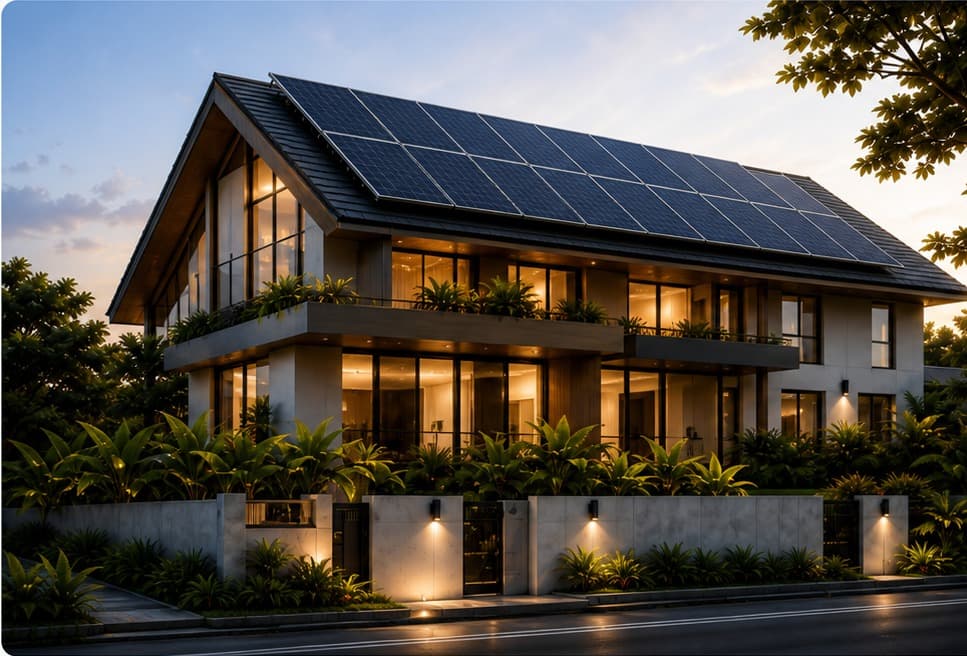
S$0.3478/kWh: Record Singapore Tariff Rewards Solar Owners
Singapore electricity hits a record S$0.3478/kWh in Q3 2026. Here is exactly what that means for your terrace house solar decision.
Key Takeaways
- 1
S$0.3478/kWh: Singapore's Q3 2026 electricity tariff is now at a record high.
- 2
A 10kWp terrace house solar system saves approximately S$3,100 per year at this tariff.
- 3
Each quarter without solar, the gap between what you pay and what solar owners pay widens permanently.

Singapore's electricity tariff just hit a record S$0.3478/kWh for Q3 2026, as CNA confirmed this week. If you own a terrace house and you are still on the grid full-time, that number is now costing you more than at any point in Singapore's history. The insight most people miss when they read headlines like this one will reshape how you think about the fixed-price plan question entirely, and by the end of this you will see why locking in a tariff is the second-best answer.
Record Tariff, Record Gap Between Grid and Rooftop
The Energy Market Authority sets Singapore's regulated tariff each quarter, and Q3 2026 lands at S$0.3478/kWh inclusive of 9% GST. For context, Q2 2026 sat at S$0.2972/kWh, meaning the tariff jumped 17% in a single quarter step , see the full data series on data.gov.sg.
That is not a rounding difference. On a typical Singapore landed home consuming 700 kWh per month, that gap translates to an extra S$75 per month compared to just three months ago.
The Record Rate Adds S$3,100 a Year to Solar's Case
Every kilowatt-hour your solar panels generate is a kilowatt-hour you do not buy from the grid at S$0.3478/kWh. That is the core arithmetic, and at record tariff levels it has never been more powerful.
A 10kWp system on a terrace house generates roughly 11,060 kWh per year (Sunnify estimate, based on Singapore's 1,106 kWh/kWp/year generation yield). With 25% self-consumption, your panels displace 2,765 kWh from the grid, saving S$961 per year at the current tariff. The remaining 75% exports to SP Group at the Solar Aggregator export credit rate of S$0.2581/kWh, earning S$2,142 per year. Total annual value: approximately S$3,100.
Over 10 years, that is S$31,000 before accounting for any further tariff increases. The system itself costs between S$10,000 and S$16,000 installed (Sunnify estimate, S$1,000 to S$1,600 per kWp), putting payback between 3.2 and 5.2 years.
Note: Export credit rates are set by EMA and reviewed periodically. Confirm the current SCT rate with your installer or at EMA's solar energy page.
Your Terrace House Numbers at the Record Rate

Step up to a 15kWp system, which suits a larger terrace house or semi-detached with adequate south-facing roof area, and the annual value reaches approximately S$4,656. That is S$46,560 over 10 years from a system costing S$15,000 to S$22,000 installed. Payback sits between 3.2 and 4.7 years, leaving 20-plus years of near-free electricity ahead of you.
Run your own numbers using your actual roof size and consumption at the Sunnify solar estimate tool. The tariff sensitivity slider will show you exactly how much each future rate increase adds to your annual savings.
Why the Fixed-Price Plan Question Gets the Wrong Answer
When you fix your tariff, you freeze your exposure. When you install solar, you eliminate it.
CNA's article asks whether you should lock in a fixed-price electricity plan now that tariffs are at a record high. The logic is sound: if you believe rates will stay high or rise further, locking in today's rate protects you.
But there is a ceiling on what locking in can do for you. It caps your upside at zero.
Solar does something structurally different. Every unit your panels generate costs you nothing from the grid, regardless of what EMA announces next quarter or the quarter after. The hint in the opening is this: the fixed-price plan is the right answer only if you do not own your roof. If you do own a terrace house, there is a better one.
Each tariff increase that passes without solar on your roof is a permanent gap. It does not close when you eventually install , it just stops growing. The S$0.3478/kWh you are paying right now will compound through every future quarter at a rate history suggests runs between 3% and 5% annually (Sunnify estimate). Solar owners installed 18 months ago were already ahead at S$0.2972/kWh. At S$0.3478/kWh they are further ahead still, and they did nothing to earn it except act earlier.
When you look at the full ROI breakdown for Singapore landed homes, the tariff trajectory is the single biggest variable in the 25-year picture. Every increase you wait through is a quarter of widening gap you never recover.
Your Move
Next October, EMA announces Q1 2027 rates. When you read that headline with panels already on your terrace house roof, you will see another quarterly saving land in your account rather than another bill arrive in your inbox.
That is the position solar owners are in today , and it is available to you the moment you run the numbers and choose a date.
Does the record tariff change my solar payback period in Singapore?
Yes, directly and immediately. At S$0.3478/kWh, every unit your panels displace from the grid is worth more than at any previous tariff rate. For a 10kWp terrace house system generating 11,060 kWh per year, the higher tariff adds roughly S$140 to S$200 per year in additional savings compared to Q2 2026 rates (Sunnify estimate), which shortens your effective payback period. Use the Sunnify estimate tool to see the updated payback figure for your specific system size.
Is now a good time to install solar in Singapore given record electricity prices?
Record tariffs make the solar financial case stronger than it has ever been in Singapore. System costs have held steady or declined, and the export credit at S$0.2581/kWh means even surplus generation earns meaningful income. EMA regulates both tariffs and export rates, so the framework is stable. See the full 2026 installation cost breakdown for current Singapore installer pricing.
See your numbers
What does this mean for your home?
Tariffs and technology change the math. The calculator uses current SP figures to show your actual payback and savings.