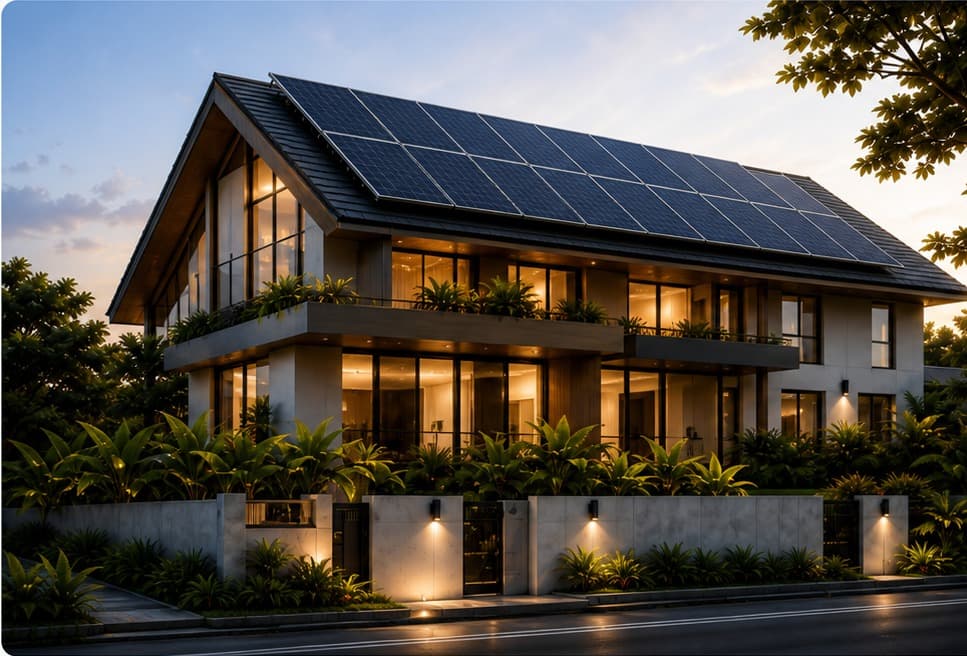
Corner Terrace vs Inter-Terrace Solar: Which Earns More
Corner terraces fit up to 15kWp of solar versus 10kWp for inter-terrace houses, a difference worth S$1,556 per year.
Why should this article concern you?
- 1
Corner terraces offer up to 120sqm of roof area versus 80sqm for inter-terrace houses.
- 2
A corner terrace earns up to S$4,656/year versus S$3,100 for a typical inter-terrace house.
- 3
Every year without solar on a corner terrace wastes its biggest structural advantage.

Your terrace house type determines your solar ceiling before your installer even sets foot on the roof. A corner terrace and an inter-terrace house sit on the same street, pay the same S$0.3478/kWh grid tariff, and face the same Singapore sun, but one of them generates up to 60% more electricity per year. By the end of this guide, you will see exactly which configuration you have, what it means in annual savings, and why the gap is larger than most installers mention upfront.
Two Roof Faces vs One: The Geometry That Drives the Numbers
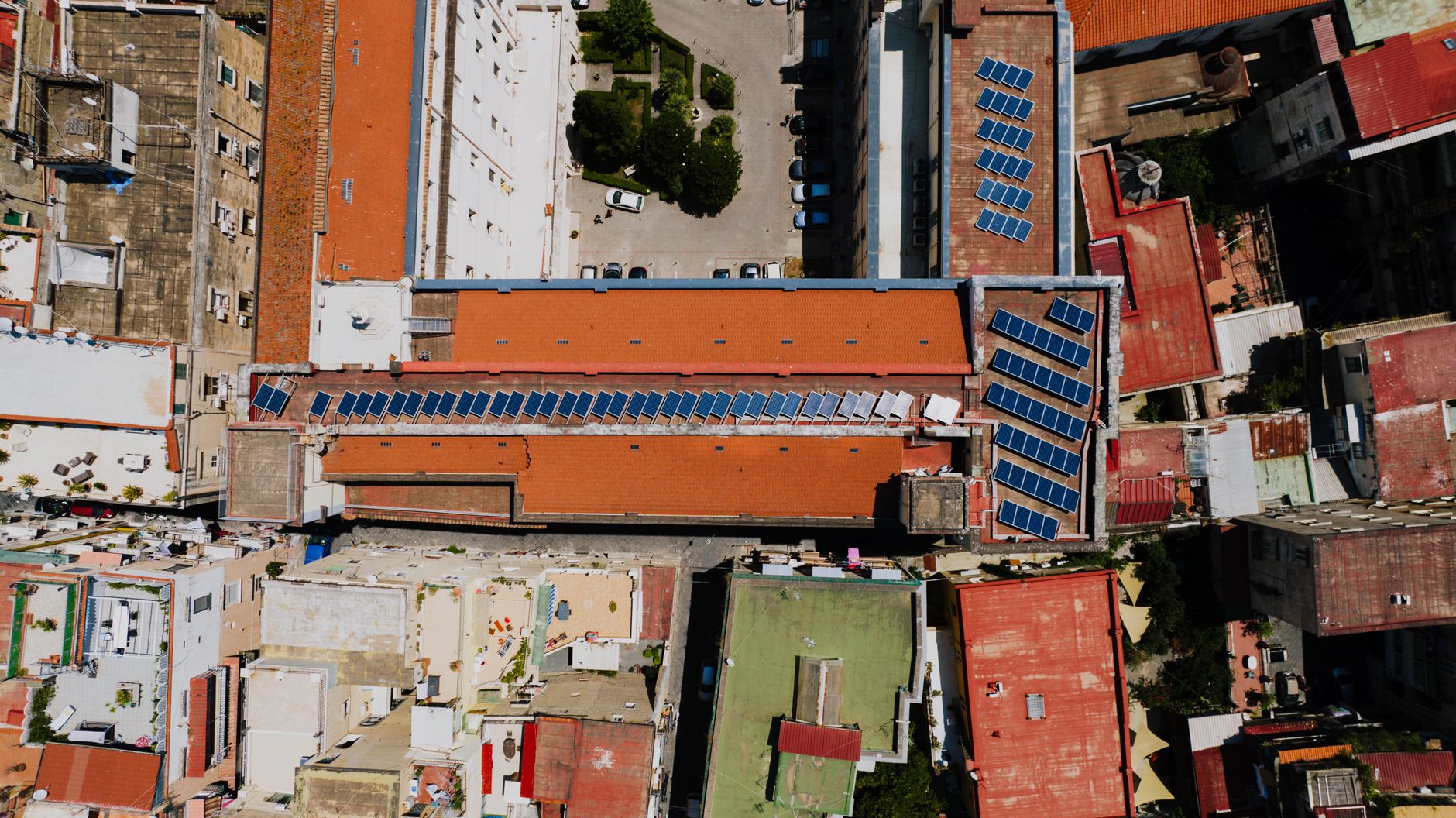
An inter-terrace house shares both long walls with neighbours. Its roof is a single span, typically 50–80sqm of usable area, bounded on both sides by party walls that block any East or West expansion. A corner terrace loses only one shared wall, which frees a second full roof face, pushing usable area to 80–120sqm.
That second face is not a bonus. It is the difference between a 10kWp system and a 15kWp system. At Singapore's 4.33 peak sun hours daily, every extra kWp you can mount adds roughly 1,106 kWh of generation per year, based on IEA solar data adjusted for Singapore's equatorial position via the International Energy Agency.
For a typical inter-terrace house running 10kWp, annual generation sits at approximately 11,060 kWh. A corner terrace at 15kWp produces around 16,590 kWh. That 5,530 kWh gap is pure value waiting to be captured, or left on the table every year you delay.
North-South vs East-West: Orientation Changes Everything on a Corner Roof
An inter-terrace house has one orientation to optimise. A corner terrace has two roof faces pointing in different directions, and how those faces align to the compass determines how you split your system. Singapore sits at 1.35°N latitude, which means true North-facing panels underperform relative to South-facing or East-West splits. The Energy Market Authority publishes Singapore's solar resource data that contextualises this through the country's generation statistics.
The optimal corner terrace configuration runs panels on both exposed faces in an East-West split. East-facing panels capture the morning peak between 08:00 and 12:00. West-facing panels take the afternoon run from 13:00 to 17:00. Together they produce a flatter, longer generation curve across the day rather than a single midday spike, which means more of your generation lands during household usage hours and less gets exported at the lower S$0.2581/kWh Solar Cashback Tariff credit.
An inter-terrace house with a North-South ridge has only one viable face. If that face happens to point North, your installer will work around it with panel tilt adjustments, but you will never recover the generation that a South or East-West orientation delivers naturally. Your neighbour in the corner unit does not have that problem.
Shading from the Shared Wall: The Inter-Terrace Penalty

Every inter-terrace house has two party walls. In the early morning and late afternoon, those walls cast shadows across the roof surface. The shadow moves as the sun tracks across the sky.
Panels caught in that shadow lose disproportionate output because string inverters pull the whole string down to the weakest panel's level. Microinverters and DC optimisers solve the string problem but they do not eliminate the shadow itself.
A 15–20% generation loss from party-wall shading is common on inter-terrace roofs where the ridge runs parallel to the shared walls (Sunnify estimate based on Singapore residential site assessments). Corner terraces eliminate this problem on their open side entirely, and the exposed second roof face never sees neighbour shading at all.
Note: Shading loss varies by street orientation, roof pitch, and neighbouring building height. Get a site-specific shade analysis from your installer before finalising panel layout. You can also assess your roof type and shading exposure using Sunnify's roof suitability guide.
The Inverter Decision: When a Corner Terrace Needs to Size Up
A 10kWp inter-terrace system typically pairs with a single 10kW inverter. A 15kWp corner terrace system running East-West faces a different equation: two separate strings pointing in opposite directions, each generating at different times of day.
A single inverter handling both strings will clip the output of whichever face is generating more at any given moment. The right solution for a corner terrace is either a dual-MPPT inverter, which tracks each string independently, or two separate inverters, one per face.
Brands like Sungrow and Huawei manufacture inverters with dual Maximum Power Point Trackers specifically for this split-orientation scenario. PV Tech lists current models with their MPPT specifications. The cost premium for dual-MPPT capability is typically S$400–S$800 over a single-MPPT unit of the same rated output, a figure you recover in less than one year from the generation improvement it unlocks.
The S$ Gap: Annual Savings Side by Side
Using Singapore Data Anchors at the current tariff of S$0.3478/kWh and SCT export credit of S$0.2581/kWh, here is what each configuration earns (Sunnify estimates for Singapore landed residential).
A 10kWp inter-terrace system generates 11,060 kWh/year. At 25% self-consumption, that is 2,765 kWh saving S$961/year in grid charges, plus 8,295 kWh exported earning S$2,142/year. Total: approximately S$3,100/year, with a system cost of S$10,000–S$16,000 and payback of 3.2–5.2 years.
A 15kWp corner terrace system generates 16,590 kWh/year. At 25% self-consumption, that is 4,148 kWh saving S$1,443/year, plus 12,443 kWh exported earning S$3,213/year. Total: approximately S$4,656/year, with system cost of S$15,000–S$22,000 and payback of 3.2–4.7 years.
The annual savings gap is S$1,556/year in favour of the corner terrace. Over a 25-year panel lifespan, that difference compounds to over S$38,000 in additional savings before accounting for tariff increases. Singapore's historical tariff data shows electricity prices have risen consistently over the past decade.
A corner terrace that installs solar at 15kWp captures S$4,656 a year. The same house that waits captures nothing and pays S$0.3478 for every unit it draws from the grid instead.
Your Numbers: Making the Corner Terrace Advantage Work
When you own a corner terrace and you install solar, you are not just adding panels to a roof. You are converting your property's structural geometry into a financial asset that pays out every single year for 25 years. The open side wall, the second roof face, the East-West orientation: these are advantages baked into the land title, and the only way to waste them is to leave the roof empty.
For inter-terrace owners, the calculus is still strongly positive. A S$3,100/year return on a S$10,000–S$16,000 investment with a payback under 5.2 years and 20+ years of free electricity ahead remains one of the best risk-adjusted returns available on a Singapore landed asset. You do not get the corner terrace's volume, but you get the same tariff, the same irradiance, and the same ROI case for going solar in Singapore.
Most installers quote a system size and a savings figure. What they rarely spell out is that the inverter type and shading from your party walls are the two factors that most often shrink that figure after installation. Those are the reasons the corner terrace gap runs larger in practice than a simple roof-area comparison suggests. When you run your personalised numbers, check how inverter type and roof orientation shift your payback figure by running the Sunnify solar estimate for your specific roof.
Both terrace house types pay S$0.3478/kWh today. Both will pay more next quarter and the quarter after. The roof geometry is fixed. The decision is not.
What does this mean for your home?
- Corner terrace owners: get a 15kWp dual-MPPT quote. Your second roof face and East-West orientation are worth an extra S$1,556/year in savings that a standard 10kWp proposal leaves uncaptured.
- Inter-terrace owners: demand a shade analysis first. Party-wall shading can cost 15–20% of generation. Microinverters or DC optimisers recover most of that loss and should be included in any written comparison quote.
- Both configurations earn strong returns at today's tariff. Run the Sunnify solar estimate to see your specific payback period, annual savings, and 25-year projection based on your actual roof area and usage.
How many solar panels can fit on a Singapore terrace house roof?
An inter-terrace house typically fits 15–25 panels across 50–80sqm of usable roof area, supporting a 7–10kWp system. A corner terrace with two exposed faces can accommodate 25–40 panels across 80–120sqm, enabling a 10–15kWp system. The exact count depends on roof pitch, ridge direction, and shading from neighbouring structures. A site assessment by a licensed solar installer gives you the definitive usable area figure for your specific unit.
Is a corner terrace house better than an inter-terrace house for solar in Singapore?
Yes, in most configurations. A corner terrace's second exposed roof face allows a larger system and an East-West panel split that generates across a longer daily window rather than peaking at midday only. At current rates, a 15kWp corner terrace system earns approximately S$4,656/year versus S$3,100/year for a standard 10kWp inter-terrace system, a gap of S$1,556/year. Inter-terrace solar still delivers a strong return. The corner terrace simply has more roof to put to work.