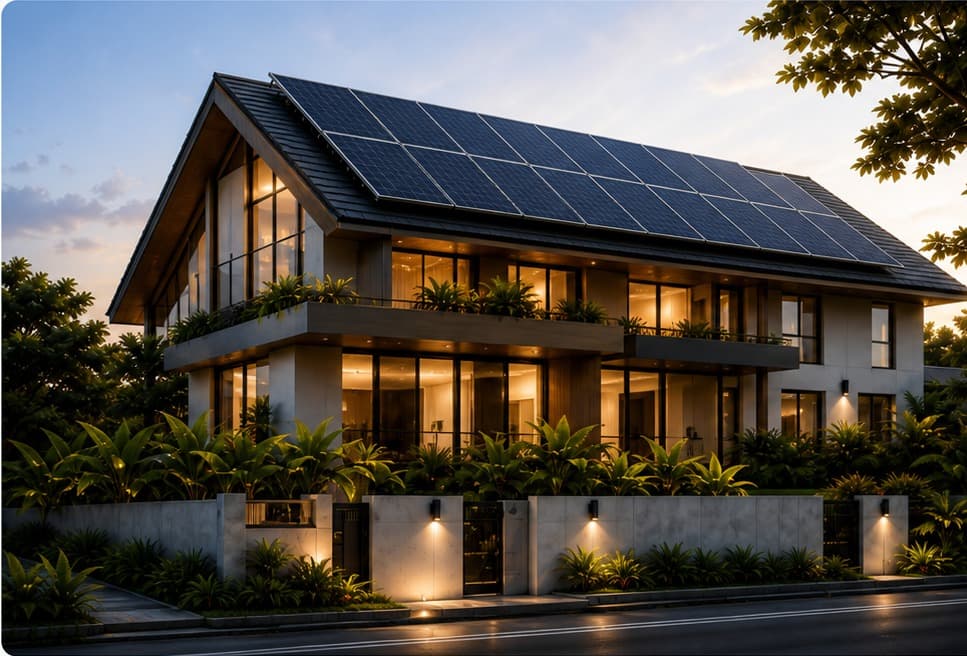
Solar Irradiance in Singapore: Why 1.3°N Gets More Sun Than You Think
Singapore receives 4.33 peak sun hours per day — an annual average that already factors in cloud cover and monsoon seasons. At latitude 1.3°N, Singapore's solar resource is approximately 30% stronger than Germany's and consistent year-round, with no winter slump.
Key Takeaways
- 1
Singapore receives an average of 4.33 peak sun hours per day — a measure that already accounts for cloud cover, monsoon rainfall, and all seasonal variation
- 2
Singapore's solar irradiance is roughly 30% higher than Germany's, despite Germany having more installed solar capacity — the difference is latitude, not weather awareness
- 3
A 10kWp Singapore system generates about 1,106 kWh per kWp per year, which is higher than comparable systems in Japan, South Korea, and most of Europe

The most common objection to rooftop solar in Singapore is that the country is too cloudy or rainy for panels to be effective. This objection is wrong, and the numbers prove it clearly. Singapore sits at 1.3° North latitude, receives among the strongest solar irradiance in any major developed economy, and generates more electricity per panel per year than comparable systems in Germany, the country that built the world's first gigawatt-scale solar market. Understanding Singapore's solar resource removes the objection entirely.
What Irradiance and Peak Sun Hours Actually Mean
Solar irradiance is the power of sunlight hitting a surface, measured in watts per square metre (W/m²). On a clear day at solar noon in Singapore, irradiance can exceed 1,000 W/m². Under cloud, it drops to 200 to 400 W/m². The irradiance fluctuates continuously through the day as the sun angle changes and clouds move.
Peak sun hours (PSH) is the engineering simplification that converts this continuous fluctuation into a single usable daily number. One PSH equals the energy equivalent of one hour of full-sun irradiance at exactly 1,000 W/m². So Singapore's 4.33 PSH means the total daily solar energy received is equivalent to 4.33 hours of perfect full-sun exposure, even though the actual sun shines for 12 to 13 hours. Cloud cover, the sun's angle relative to the panels, and atmospheric scattering all reduce the effective yield. The 4.33 PSH figure from Singapore's meteorological data already captures all of these effects as an annual average.
Singapore vs the Rest of the World
| Country | Latitude | Avg PSH/day | kWh/kWp/yr (est.) | vs Singapore |
|---|---|---|---|---|
| Singapore | 1.3°N | 4.33 | ~1,106 | Baseline |
| Australia (Sydney) | 34°S | ~4.50 | ~1,150 | +4% |
| Japan (Tokyo) | 36°N | ~3.60 | ~920 | -17% |
| South Korea (Seoul) | 37°N | ~3.50 | ~895 | -19% |
| Germany (Munich) | 48°N | ~3.00 | ~770 | -30% |
| United Kingdom (London) | 51°N | ~2.70 | ~690 | -38% |
Germany installed over 90 GWp of solar despite having 30% less solar resource than Singapore. The argument that Singapore is "not suitable for solar" collapses on contact with this comparison. The question is not whether Singapore has enough sun, it has substantially more than the country that built the solar industry.
Why Monsoon Does Not Ruin the Calculation
Singapore has two monsoon seasons: the northeast monsoon (December to March, wetter) and the southwest monsoon (June to September, drier). Both bring cloud and rainfall on some days. The common intuition is that this must significantly reduce solar output for half the year.
It does, on individual monsoon days. But the annual average of 4.33 PSH already incorporates both monsoon seasons, all inter-monsoon rainfall, and every overcast day across decades of meteorological data. You are not looking at a sunny-season figure and then being surprised by monsoon. The 4.33 PSH is the full-year average with monsoons included. Your system's annual generation estimate is built on this figure.
The critical difference from high-latitude markets: Singapore has no winter. A German system generates barely 1 PSH per day in December. A Singapore system generates approximately 3.8 to 4.5 PSH every single month of the year. Year-round consistency is what makes Singapore's solar resource more bankable than the raw PSH comparison with Australia suggests, there is no planning for a dead season.
Germany built the world's first major solar market at 48°N with 30% less solar energy than Singapore. The objection that Singapore is "too cloudy for solar" is not a concern about physics. It is a gap in information.
The data.gov.sg climate datasets include Singapore's historical irradiance measurements that underpin the 4.33 PSH figure used in the Sunnify calculator. The EMA also publishes solar generation statistics for Singapore's installed capacity in its annual energy statistics report. Use the Sunnify estimate tool to see how your specific roof orientation and available area translate the 4.33 PSH benchmark into actual kilowatt-hours and dollars for your home.
Further reading: IRENA global solar atlas · NEA meteorological data for Singapore.
What is Singapore's Global Horizontal Irradiance (GHI)?
GHI measures the total solar radiation received on a horizontal surface, combining direct beam radiation and diffuse (scattered) radiation from the sky. Singapore's annual GHI is approximately 1,580 to 1,620 kWh/m² based on long-run meteorological measurements. For roof-mounted panels at a tilt angle of 5 to 15 degrees (typical for Singapore's shallow-pitch roofs), the annual irradiance on the panel surface is slightly lower than the GHI because the panels are not optimally tilted. The 4.33 PSH figure used in Singapore solar calculations is derived from GHI measurements corrected for typical Singapore roof angles and system loss factors.
Does Singapore's latitude mean panels should face south?
In the northern hemisphere, solar panels face south to maximise sun exposure throughout the year. In Singapore at 1.3°N, practically on the equator, the sun passes almost directly overhead. This means north, south, east, and west-facing roofs all receive meaningful direct irradiance throughout the year, though north and south faces still outperform east and west in total annual yield by approximately 10 to 15%. For terrace houses where the roof has both north and south pitches, most installers will put panels on whichever face has fewer obstructions and better structural access. Both are productive.
See your numbers
What does this mean for your home?
Tariffs and technology change the math. The calculator uses current SP figures to show your actual payback and savings.