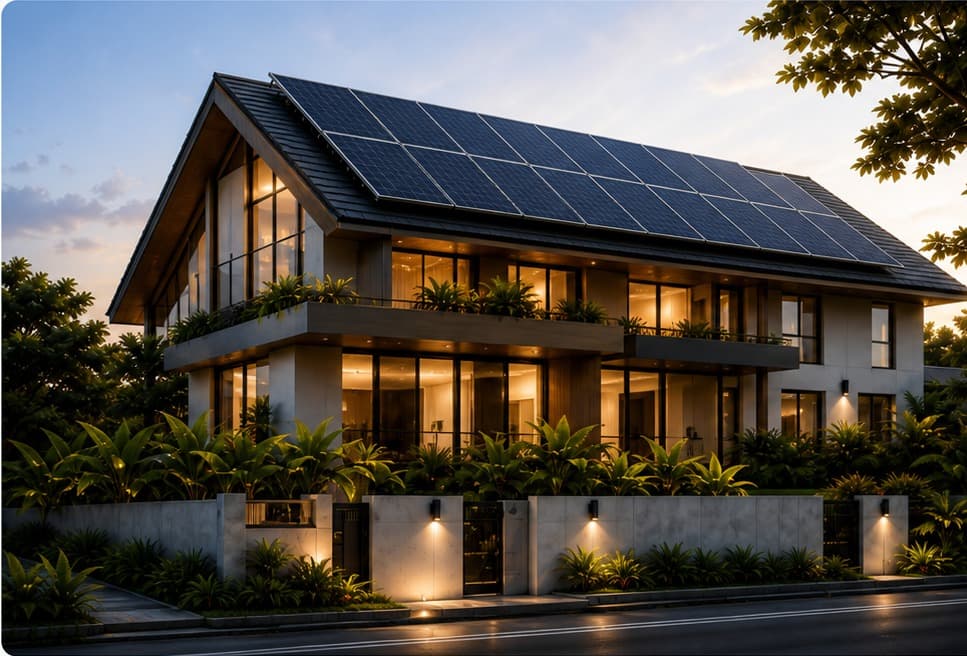
Singapore Green Plan 2030 and Rooftop Solar: What Homeowners Should Know
Singapore's Green Plan 2030 includes a 2 GWp solar target under its Energy Reset pillar. For landed homeowners, the plan creates a stable policy environment for ECIS and the Solar Crediting Tariff through 2030. The plan's commitments also signal that carbon pricing will continue rising, reinforcing solar economics year on year.
Key Takeaways
- 1
The Green Plan 2030's Energy Reset pillar targets 2 GWp of solar capacity — residential landed homes are a named contributor alongside HDB rooftops and floating solar
- 2
Green Plan sustainability commitments have been used to justify and maintain the ECIS export credit scheme — if the government missed its solar targets, residential incentives would likely be first to be defended
- 3
2026 to 2028 sits in the highest-momentum window of Singapore's solar buildout — most of the policy infrastructure supporting residential installation is at peak stability

Singapore's Green Plan 2030 is a whole-of-government sustainability plan published in 2021, coordinated across five ministries. It sets specific, measurable targets across five pillars: City in Nature, Sustainable Living, Energy Reset, Green Economy, and Resilient Future. For Singapore homeowners considering rooftop solar, the Energy Reset pillar is the most directly relevant, it contains the 2 GWp solar capacity target and the supporting policy commitments that make residential solar economics predictable through the decade.
The Energy Reset Pillar and What It Commits To
The Energy Reset pillar aims to reduce Singapore's carbon intensity and expand clean energy. The solar component of this is the 2 GWp by 2030 target, which is supported by several specific programmes: SolarNova (HDB and public sector rooftops), floating solar developments (Tengeh Reservoir and planned expansions), commercial and industrial rooftop procurement, and residential incentives including ECIS.
The Green Plan also commits to achieving at least 80% of buildings to achieve Green Mark standards by 2030. While this applies primarily to commercial and public buildings, it signals a broader shift in Singapore's built environment standards that affects appliance efficiency, insulation, and energy management in new residential construction, reducing the baseline electricity consumption that solar needs to offset.
What the Green Plan Means in Practice for a Landed Homeowner
For a homeowner deciding whether to install solar in 2026, the Green Plan's significance is not symbolic. It is policy insurance. The three specific implications:
ECIS stability: EMA cannot responsibly wind down the export credit scheme before the 2030 target is met. Doing so would reduce the economic incentive for new residential installations and slow progress toward the stated target, which would constitute a public failure on a multi-ministry commitment. The ECIS framework is effectively defended by the political weight of the Green Plan through 2030.
Carbon tax escalation: The Green Plan's carbon pricing roadmap (S$25/tonne in 2024, S$45/tonne in 2026, S$50 to S$80/tonne by 2030) is legislated under the Carbon Pricing Act. This is not a target, it is law. The carbon cost embedded in electricity tariffs will rise predictably through 2030, and solar generation sidesteps this cost entirely on every kWh generated.
Import diversification: The Green Plan includes Singapore's commitment to import up to 4 GW of low-carbon electricity from regional grids by 2035 (through the ASEAN Power Grid and bilateral agreements with Malaysia, Indonesia, and others). If this proceeds, it may eventually change the economics of domestic solar export, but not before 2030, and existing ECIS registrations are expected to be grandfathered under the current scheme terms.
How to Think About the Post-2030 Landscape
The honest picture: after 2030, the policy environment for residential solar export becomes less certain. If Singapore hits the 2 GWp target, EMA's incentive to maintain the full SCT for new residential installations reduces. If low-carbon electricity imports from regional grids materialise at scale, the wholesale generation cost (which sets the SCT baseline) could fall, reducing the SCT rate. These are post-2030 risks, not immediate concerns, and they apply to new installations after the target is met, existing ECIS registrations have historically been treated as established rights under the prevailing scheme terms.
For a homeowner installing in 2026, the policy window is clearly favourable. The 2030 target provides stability for four more years. The carbon escalation is locked in by law. The financial case stands on its own regardless of what comes after 2030, because the 4-year payback means the investment is recovered before any policy change matters.
The Green Plan's solar target is not aspiration. It is a multi-ministry commitment tracked publicly every year. The policy framework supporting your export credits exists because the government needs you to install.
The full Green Plan 2030 document is available at Singapore's official sustainability portal. The EMA's annual energy statistics report tracks progress against the 2 GWp solar target and other Energy Reset commitments. For your home's contribution to Singapore's clean energy future and your personal financial return, run the Sunnify estimate tool.
Further reading: Singapore Green Plan 2030 official site · NCCS Singapore climate targets 2030 · EMA Singapore solar development roadmap.
Does the Singapore Green Plan offer any direct incentives for homeowners to install solar?
The Green Plan itself is a strategic framework, not a grant programme. The direct financial incentive for residential solar in Singapore is the ECIS export credit scheme administered by EMA through SP Group. There are no cash grants or tax rebates for private landed homeowners installing solar as of 2026. HDB residents benefit from SolarNova through HDB directly. The government's approach for private residential is to make the economics work through the tariff and export credit framework, not direct subsidies, which is consistent with Singapore's broader approach to market-led deployment.
Where can I track Singapore's progress toward the 2 GWp solar target?
EMA publishes annual energy statistics including solar installed capacity, new additions by segment, and generation figures. These are available on the EMA website and typically released in Q1 of the following year. The EMA website also publishes the Singapore Energy Statistics report, which includes the solar deployment tracker. Singapore's overall Green Plan progress is tracked at the greenplan.gov.sg portal, which publishes progress reports across all five pillars annually.
See your numbers
What does this mean for your home?
Tariffs and technology change the math. The calculator uses current SP figures to show your actual payback and savings.