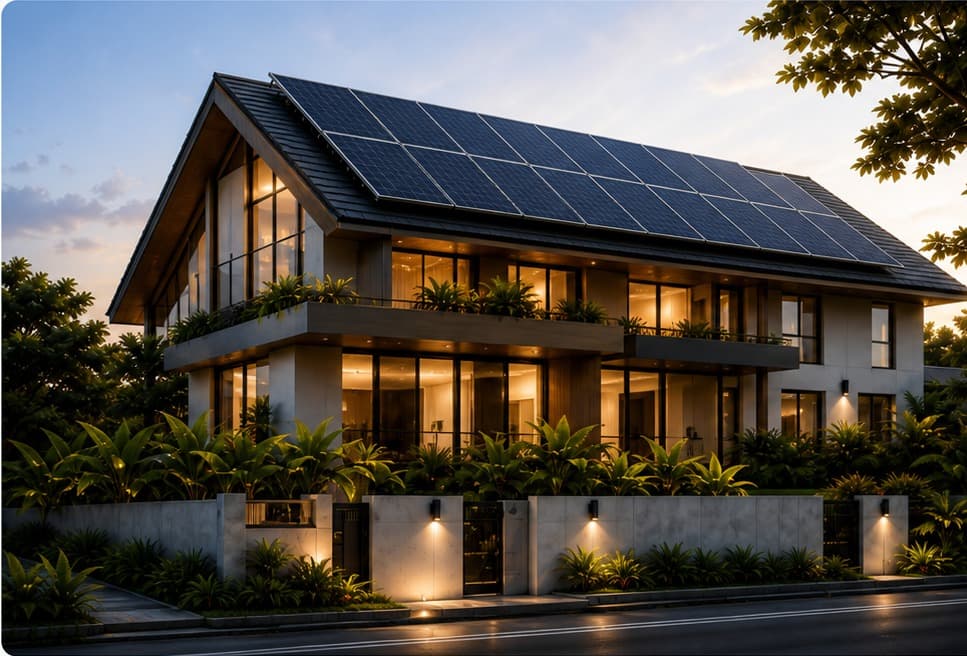
EV Charging with Solar and Battery in Singapore: The Complete Home Energy Setup
Adding an EV to a Singapore solar and battery system changes the sizing math. Here is how to configure the right solar, battery, and charger combination so your car charges on sunlight instead of the grid.
Why should this article concern you?
- 1
Charging an EV from home solar instead of the grid at S$0.3478/kWh saves S$500 to S$1,000 per year depending on daily commute distance; these savings stack on top of the household electricity savings from the solar system
- 2
A 7.4 kW AC home charger (Type 2) is the practical standard for Singapore landed homes: it charges a 60 kWh EV from 20% to 80% in under 6 hours, fits in a single-phase supply, and costs S$1,200 to S$2,500 installed
- 3
The optimal setup for an EV owner is a 15 kWp solar system with a 20 to 25 kWh battery, sized to cover both evening household load and overnight EV charging; the combined payback runs 5 to 7 years at Q3 2026 tariffs

The question we get more than any other in 2026 is not just about solar or just about EVs. It is: how do I set up my home so my car charges on sunlight? For Singapore landed homeowners, that is now a practical question, not a theoretical one. The battery storage guide covers the sizing and cost; this article focuses on the EV-specific configuration.
The Three-Layer System
A complete solar-battery-EV setup for a Singapore landed home has three layers. First: the solar system generates power during the day. Second: the battery stores what the household does not use immediately. Third: the EV charger draws from stored solar overnight.
Most Singapore homeowners with EVs are currently on single-phase power supply. That limits the maximum AC charger speed to 7.4 kW (Type 2, 32A), which is sufficient for overnight charging. Three-phase supply at 22 kW is available in some landed homes and opens up faster charging options.
The EV Charging Economics
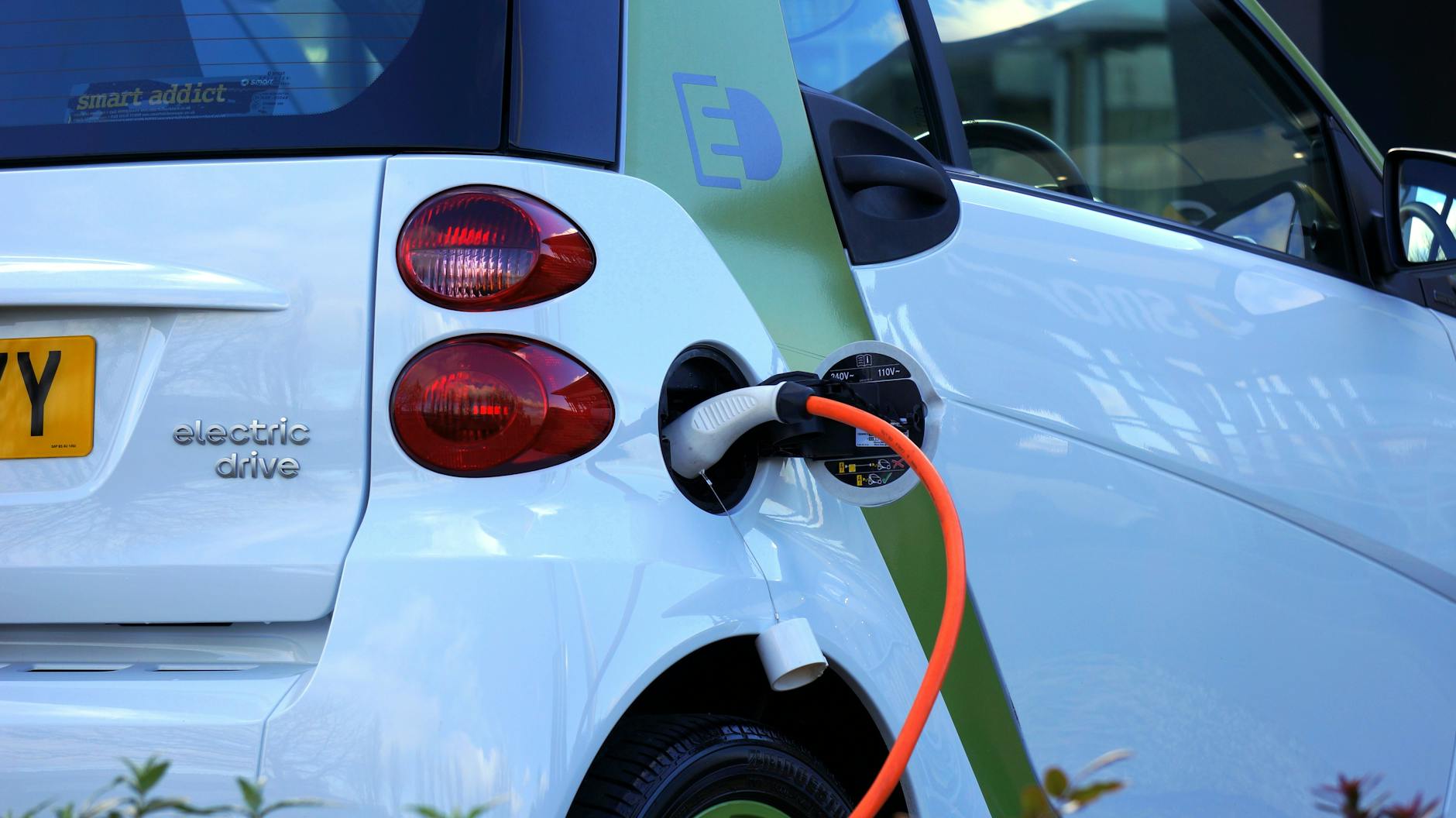
A Singapore EV owner driving 40 to 60 km per day uses roughly 8 to 12 kWh per night of charging. At the grid tariff of S$0.3478/kWh, that is S$1,014 to S$1,521 per year in charging cost. At S$0.00/kWh from stored solar, the saving is the full amount.
In practice, the battery stores solar surplus from the day and dispatches it to the EV charger overnight. A 20 to 25 kWh battery covers both the evening household load (8 to 12 kWh) and the overnight EV charge (8 to 12 kWh) without drawing from the grid. Smaller batteries force a choice: prioritise household load or EV charging.
The Right Charger for Singapore Landed Homes
A 7.4 kW Type 2 AC charger is the practical standard. It charges most Singapore EVs (Hyundai Ioniq 5 at 77.4 kWh, BYD Atto 3 at 60.5 kWh, Tesla Model 3 at 57.5 kWh) from 20% to 80% in 5 to 7 hours overnight. Cost installed: S$1,200 to S$2,500 depending on whether a dedicated circuit from the DB board is needed.
For three-phase homes, a 22 kW Type 2 charger reduces charge time to 2 to 3 hours but requires three-phase supply at the DB board. Most Singapore terrace and semi-detached houses are single-phase; bungalows are more likely to have three-phase. Confirm with your installer before specifying a 22 kW charger.
Smart Charging and Solar Integration
A smart EV charger with solar integration controls charging to match solar surplus during the day, battery reserve levels in the evening, and grid draw as the last resort. Popular options compatible with Singapore voltage (230V/50Hz): Wallbox Pulsar Plus, Zappi (myenergi), and the Tesla Wall Connector (for Teslas). Your solar inverter may also offer EV charging control natively if you use a Huawei or Sungrow ecosystem.
Without smart charging, the EV charger draws from whatever is available in priority order. With smart charging, the system can be configured to: (1) charge the EV from solar surplus during the day if you work from home, (2) charge from battery at night if sufficient surplus was stored, and (3) draw from grid only if battery falls below a set reserve.
The combined system saves most not from any one piece, but from the interaction between them. Solar generates. Battery stores. EV charger dispatches at night. Each layer pays for itself; together they push annual grid spend from S$6,800 to under S$2,000.
For the battery sizing required to cover EV charging, see the battery sizing guide. For the full battery brand comparison, see the brand comparison article. The hub for all battery content is the battery storage resource guide.
Further reading: how to size your battery for a Singapore home with an EV · battery storage ROI and payback in Singapore · battery storage cost and sizing guide.
What does this mean for your home?
- An EV makes the case for adding battery storage to solar much stronger. Without an EV, the marginal battery payback is 14 to 19 years. With an EV charging overnight from stored solar, the battery saves S$1,000 to S$1,500 per year in combined household and charging costs, improving its marginal payback to 7 to 10 years.
- If you are planning to buy an EV in the next 3 years, size your solar and battery for it now. Adding battery at the time of solar installation costs significantly less than retrofitting. Future-proofing the inverter (choose a hybrid inverter with 20-25 kWh battery capacity) and roughing in the EV charger circuit at the same time saves a separate mobilisation cost.
- Run the numbers for your specific commute distance and home consumption. Use the Sunnify estimate and include your monthly electricity bill and approximate EV charging needs. The combined payback for a Singapore landed home with a 15 kWp solar system, 20 kWh battery, and one EV charging daily typically runs 5 to 7 years.
Can I charge my EV directly from solar panels without a battery?
Yes, with a smart charger that throttles charge speed to match solar surplus in real time. The challenge is that solar generation peaks at noon, while most Singapore homeowners charge their EV in the evening when they return from work. Without a battery, daytime excess solar exports at S$0.2581/kWh rather than charging the EV at S$0.3478 replacement cost. A battery bridges the timing gap, storing daytime surplus for evening EV charging. Direct solar-to-EV charging (via Zappi or similar) works best if someone is home during the day and can plug in the car during peak generation hours.
Do Singapore electricity tariffs apply to home EV charging?
Yes. Home EV charging in Singapore uses your household electricity supply and is billed at the standard SP Group regulated rate of S$0.3478/kWh (Q3 2026). There is no separate EV electricity tariff for residential customers. Public chargers (SP Mobility, Shell Recharge, Charge+) are billed separately at rates typically ranging from S$0.38 to S$0.60/kWh depending on charger speed and operator. Home charging from solar, therefore, is significantly cheaper than both grid home charging and public charging.